

Best Mattress for Couples Who Prefer Different Firmness

Updated: 4 days ago
Why Couples Struggle to Agree on a Mattress
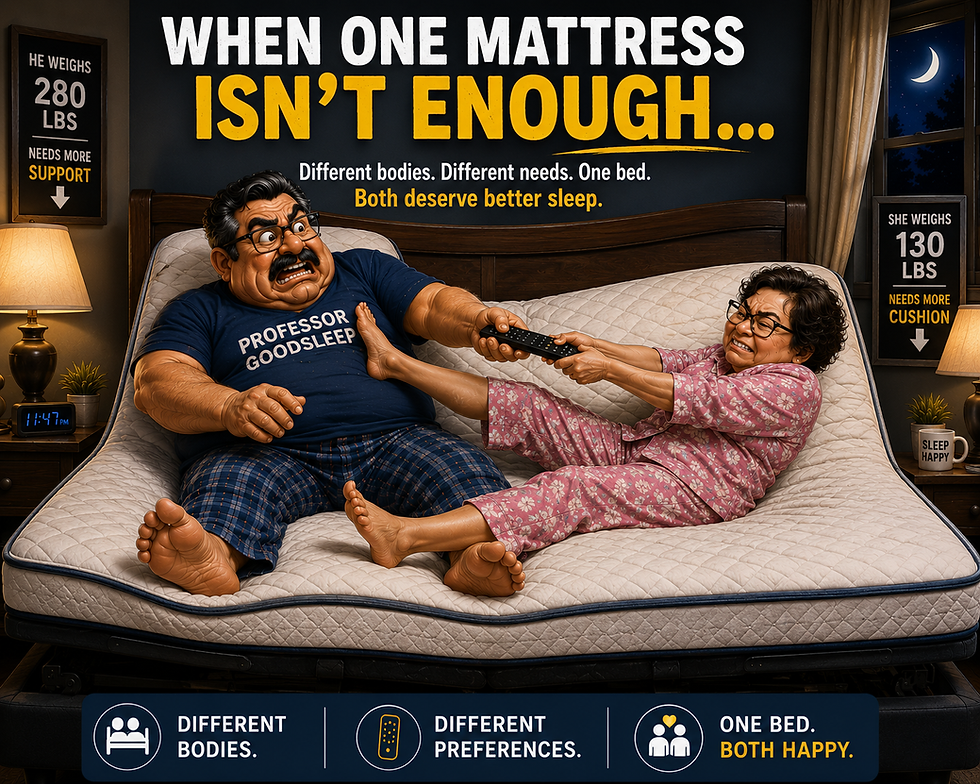
Quick Take: Buying a mattress as a couple is one of the most challenging purchases you'll make because two people often need completely different things. Imagine Big Larry, who weighs 280 pounds, and Tina, who weighs 140 pounds. Larry needs stronger support to keep his spine aligned, while Tina needs softer pressure relief around her shoulders and hips. The goal isn't finding one mattress both people tolerate—it's finding a sleep system that lets both wake up rested.
Situation Best Starting Point
Similar weight & preferences: One king mattress
Moderate comfort differences: Same mattress collection in different firmness'
Large weight or comfort differences: Split king
Maximum adjustability: Air-adjustable mattress
Still not sure which mattress fits you?
Your sleep position, body weight, pressure points and budget can change the answer. Answer a few questions and I’ll narrow more than 100 mattresses to the few I’d actually put you on.
Free • About 2 minutes
Buying a Mattress Shouldn't Start an Argument
Buying a mattress should be exciting. Instead, it's one of the few purchases where couples often discover they want completely different beds. One partner says, "This is way too firm," and the other immediately replies, "I'm sinking." I've watched this exact conversation play out hundreds of times on the sales floor. Most couples assume someone has to compromise. In many cases, they don't—they simply haven't been shown the right solutions.
Meet Big Larry and Tina
Big Larry works a physical job, weighs about 280 pounds, sleeps mostly on his back, and needs strong support to keep his hips from sinking too deeply. Tina weighs about 140 pounds, sleeps primarily on her side, and needs enough cushioning to relieve pressure on her shoulders and hips. Neither person is wrong; their bodies simply interact with the same mattress in completely different ways.
Why Body Weight Changes Everything
One way I explain this in the showroom is to imagine two people walking through fresh snow. A lighter person barely leaves footprints, while a heavier person sinks much deeper. The same thing happens with a mattress. Larry compresses the comfort layers much farther than Tina does, so the same mattress can feel supportive to one person and painfully firm—or too soft—to the other.
Big Larry (280 lbs) | Tina (140 lbs) |
Compresses deeper into mattress | Compresses comfort layers less |
Needs stronger support | Needs more pressure relief |
More likely to sleep warm | Often sleeps cooler |
Wears materials faster | Places less stress on materials |
From the Sales Floor
I've seen couples try six, eight, even ten mattresses before realizing they weren't looking for one perfect mattress—they were trying to solve two different sleep problems. Once you stop thinking about finding one 'magic' mattress and start thinking about finding the right solution for each partner, the buying process becomes much less frustrating.
Part 2: Comparing the Best Solutions
Why a Compromise Mattress Usually Doesn't Work
Once couples understand that two different bodies experience the same mattress differently, the idea of simply "meeting in the middle" starts to make less sense. If Big Larry chooses the mattress that supports his 280-pound frame, Tina may wake up with sore shoulders and hips because she never sinks into the comfort layers. Conversely, if Tina chooses the plush mattress she loves, Larry may sink too deeply, lose spinal alignment, and wear the mattress out faster.
If Larry Wins:
Great support for Larry
Tina may feel pressure on shoulders and hips
Mattress feels too firm to Tina
If Tina Wins:
Excellent pressure relief for Tina
Larry may lose lower-back support
Mattress may wear faster under Larry

Option #1 – One Medium Mattress
For couples with similar body types and only small differences in comfort preferences, a medium mattress is often the simplest and least expensive solution. It keeps costs down and avoids the complexity of split systems. However, when weight or sleeping style differs dramatically, someone usually ends up compromising.
Option #2 – The Same Mattress Collection in Different Firmness'
This is often the first solution I explore on the sales floor. Many manufacturers offer the same collection in Plush, Medium, and Firm. This allows each partner to get a different feel while keeping the appearance of the bed much more consistent than mixing unrelated mattress models.
The Hidden Height Difference
Even within the same mattress collection, different firmness levels are not always exactly the same height. A plush model often contains thicker comfort layers or a deeper pillow top, making it one or two inches taller than the firm version.
Think of it this way: imagine putting a mattress topper on only one half of your king mattress. That's essentially what happens when one side is noticeably taller than the other. Some couples don't care; others notice the ridge every night.
From the Sales Floor
Before I order two different firmness', I always compare the published heights and, if possible, see the mattresses side by side. It's much easier to have that conversation before delivery than after the bed is in your home.
Professor Goodsleep's Recommendation
If Big Larry and Tina walked into my showroom, this is usually where I'd start.
Part 3: Split Kings, Adjustable Bases, and Air-Adjustable Mattresses
Option #3 – Split King Mattresses
A split king is made by placing two Twin XL mattresses side by side on a king-size frame. Each partner gets to choose the comfort level that best fits their body while still enjoying the overall size of a king bed. For couples with dramatic differences in body weight or firmness preference, it's often one of the best long-term solutions.
Advantages
Each person chooses their own comfort
Excellent for large weight differences
Works perfectly with adjustable bases
Easy to replace one mattress later
Potential Drawbacks
Noticeable split down the center
Higher overall cost
Requires split king sheets
Less ideal if you sleep in the middle every night
The 'Crack in the Middle' Question
Almost everyone asks about the split between the mattresses. The truth is that many couples adjust quickly, especially if each partner mostly stays on their own side. However, if you enjoy sleeping right in the center of the bed or frequently cuddle across the middle, you'll probably notice the gap. I've even had customers joke that a knee or elbow occasionally finds 'the crack' during the night.

Can You Still Cuddle?
Absolutely. Many couples cuddle before falling asleep and then naturally drift back to their own side. If spending the entire night in the center of the bed is important to you, a split king may not be your favorite solution. If sleeping comfortably all night is the priority, many couples feel the tradeoff is worthwhile.
From the Sales Floor
One thing I've learned is that couples often worry far more about the center split before they own a split king than after they own one. Comfort usually becomes a much bigger priority than the small gap between the mattresses.
Can Adjustable Bases Help With Different Mattress Heights?
Yes—sometimes they can. This is something many shoppers never hear about. Many adjustable bases use stackable or removable leg sections. If one mattress ends up a couple of inches taller than the other, lowering one adjustable base by removing a leg section can often bring the sleeping surfaces surprisingly close together. It doesn't work with every base, but it's an option I always keep in mind when planning a split king installation.
Another creative solution is putting a small block or riser under the legs of the thinner mattress to make the height difference less noticeable.
Option #4 – Air-Adjustable Mattresses
Air-adjustable mattresses, including systems from Sleep Number and similar manufacturers, allow each sleeper to adjust firmness independently using air chambers. For couples with dramatically different comfort preferences, this can be an excellent solution.
From my perspective, they're worth considering—but they're not automatically the best answer for everyone. They're typically among the most expensive mattress options and include pumps, hoses, air chambers, electronics, and remote controls. More components mean more complexity. Before purchasing, I encourage customers to understand exactly what the warranty covers and to recognize that air systems may eventually require service.
Motion Transfer Matters
When one partner gets out of bed, rolls over, or changes position, the other person shouldn't feel like they're riding a wave. Couples should pay close attention to motion isolation, especially if one partner is a light sleeper. Hybrid and memory foam mattresses generally reduce motion better than traditional connected-coil systems.

Temperature Differences
Another issue couples rarely discuss is temperature. Big Larry may naturally sleep much warmer than Tina simply because of the difference in body mass. Cooling fabrics, breathable comfort layers, individually wrapped coils, and adjustable bases can all contribute to a more comfortable sleeping environment.
Professor Goodsleep Report Card
Solution | Comfort | Flexibility | Long-Term Value | Grade |
Split King | ★★★★★ | ★★★★★ | ★★★★★ | A+ |
Air-Adjustable | ★★★★★ | ★★★★★ | ★★★★☆ | A- |
Part 4: Real-World Advice, Common Mistakes & Final Recommendations
Real Couples I've Helped
Couple #1 – Big Weight Difference
One of the most common situations I see is a couple very much like Big Larry and Tina. He needed considerably more support while she needed far more pressure relief. Once we stopped searching for one 'perfect' mattress and started discussing sleep systems instead, the buying process became much easier.
Couple #2 – Same Weight, Different Preferences
Another couple was nearly identical in size, yet one loved an ultra-plush feel while the other wanted something much firmer. The solution wasn't about body weight at all—it was about personal comfort preferences.
Couple #3 – Back Pain vs. Shoulder Pain
Sometimes one partner is shopping because of lower back pain while the other is trying to relieve shoulder pressure. Those are completely different problems, and they often require a different approach than simply buying the firmest mattress in the store.
The Biggest Mistakes Couples Make
Shopping for only one person's comfort.
Ignoring body weight and sleeping position.
Assuming firmer is always better.
Choosing two completely different mattresses without checking their finished heights.
Buying the cheapest option instead of the one that solves both partners' problems.
Forgetting to consider an adjustable base as part of the overall sleep system.
Mattress Buying Checklist
☐ Know each partner's preferred sleeping position.
☐ Discuss firmness preferences before shopping.
☐ Compare finished mattress heights if considering different firmnesses.
☐ Test mattresses together whenever possible.
☐ Think about future needs—not just how the mattress feels today.
☐ Consider whether an adjustable base could improve comfort.
Which Solution Fits You?
Your Situation | Recommended Starting Point |
Similar body types and preferences | One quality king mattress |
Different comfort preferences | Same collection in different firmnesses |
Large weight difference | Split king |
Maximum adjustability desired | Air-adjustable mattress |
Frequently Asked Questions
Can two people with very different body weights sleep comfortably on the same mattress?
Yes, but choosing the right mattress—or sleep system—is much more important than simply picking a firmness.
Is a split king only for adjustable bases?
No. Many couples choose a split king simply because they need different comfort levels.
Will I notice the split in the middle?
Most couples notice it less over time than they expected, although people who sleep in the center may prefer a traditional king mattress.
Should I buy the mattress my partner likes?
The goal isn't for one person to win. It's to find the solution that lets both people sleep comfortably.
Final Comparison Table
Your Situation | Recommended Solution | Why It Works |
Similar body types & preferences | One quality King mattress | Simple, affordable, and no center split. |
Similar size, different firmness preferences | Same mattress collection in different firmnesses | Keeps the bed looking consistent while improving comfort for both. |
100+ lb weight difference | Split King | Allows each person to choose the support and pressure relief they need. |
Different sleep positions | Split King + synchronized Twin XL adjustable bases | Each sleeper can use their own ideal sleeping position. |
Maximum customization | Air-adjustable mattress | Independent firmness adjustment, but higher cost and more mechanical parts. |
Motion transfer is a concern | Hybrid or memory foam with individually wrapped coils | Reduces partner disturbance when one person moves. |
Best long-term value for heavier couples | Split King + synchronized Twin XL adjustable bases | Less strain on motors, easier to move, future flexibility, and excellent comfort. |
Professor Goodsleep's Recommendation: Don't shop for one mattress both people can tolerate. Shop for the sleep system that lets both people wake up rested.
Professor Goodsleep's Final Recommendation
If I could give one piece of advice after years on the sales floor, it would be this: stop searching for one mattress that both people can tolerate and start looking for the sleep system that gives each person what their body actually needs. Sometimes that's one mattress. Sometimes it's the same model in different firmness'. Sometimes it's a split king. The right answer depends on the people—not the advertising.
Final Thoughts
Buying a mattress together shouldn't become a contest where one partner wins and the other settles. The best mattress isn't the one that feels perfect to one person—it's the one that helps both people wake up feeling rested, supported, and ready for the day. Take the time to understand your differences, ask good questions, and choose the solution that fits both of you, not just one of you.
If you are still comparing options for two different firmness preferences, get 3–5 mattress recommendations instantly with the free consultation. No email is required.
Don't Worry, Sleep Happy.
-Professor Goodsleep



Comments