

Best Mattress for Heavy Couples: Support, Cooling and Durability

Updated: 4 days ago

Quick Answer
For most heavier couples, a durable hybrid is the best place to start. Look for resilient comfort layers, a strong transition layer, individually wrapped coils or another stable core, reinforced edges, good motion control, and a foundation rated for the complete load.
The thickest mattress and the firmest mattress are not automatically the best. Construction quality and correct firmness for both sleepers matter more.
Still not sure which mattress fits you?
Your sleep position, body weight, pressure points and budget can change the answer. Answer a few questions and I’ll narrow more than 100 mattresses to the few I’d actually put you on.
Free • About 2 minutes
Why Couples Create a Different Durability Problem
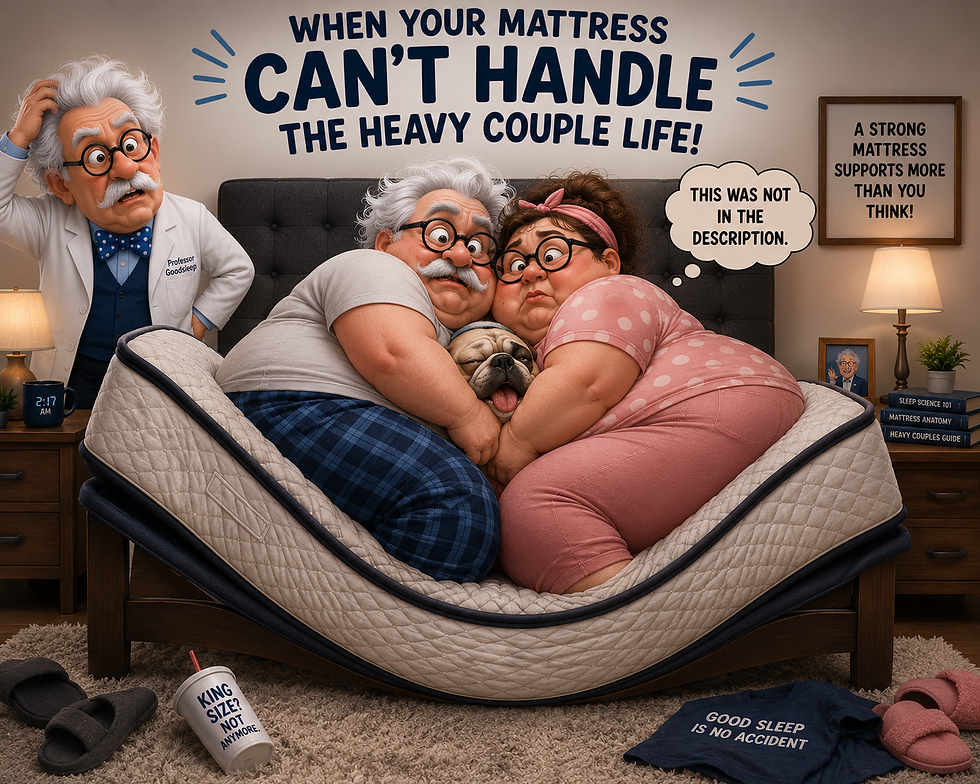
Two sleepers add more than combined scale weight. They add movement, heat, repeated compression, and more edge use. The center third of the mattress usually works hardest because it supports the hips and lower backs while also collecting the most body heat.
A mattress can feel comfortable in a showroom and still lack the transition-layer strength needed to prevent both sleepers from sinking through the top layers after several hours.
Starting Points by Combined Weight
Combined Weight | Useful Starting Construction | Main Watch-Out |
Under about 400 lb | Durable medium or supportive medium hybrid | Do not sacrifice pressure relief |
About 400–550 lb | Stronger transition layers and reinforced hybrid support | Center sink and weak edges |
Over about 550 lb | Heavy-duty design, latex, or specialized support system | Published limits for mattress and base |
Large firmness difference | Split king or dual-comfort option | Center seam and higher cost |
Combined weight is only a starting screen. A 250-pound side sleeper and a 250-pound stomach sleeper should not automatically choose the same surface firmness.
The Six Construction Details I Check First
Comfort-layer durability: The upper foam must relieve pressure without softening rapidly under repeated load.
Transition support: This is the overlooked layer that keeps sleepers from bottoming out.
Support core: Pocketed coils, latex, or dense support foam must remain stable across the full surface.
Edge reinforcement: Strong edges create more usable width and help with entering and leaving the bed.
Motion isolation: Individually wrapped coils and quality comfort materials reduce partner disturbance.
Foundation capacity: The frame, slats, foundation, and adjustable base all need to support the complete system.
Why Mattress Thickness Is a Distraction
A well-built 12-inch mattress can outperform a 16-inch pillow top made with less durable foam. The extra height only helps when the added material has a useful job. Read Mattress Thickness for Heavy People before paying for height alone.
Foam Quality and Real Comfort Life
Mattress warranties generally measure visible defects; they do not guarantee that comfort and support will remain unchanged. Lower-density comfort layers can soften substantially without producing a deep enough unloaded impression for a warranty claim. Compare the foam-density guide and the mattress warranty guide.
Motion Isolation Without a Dead Feel
Solid memory foam often controls motion well but can feel warm and difficult to move through. Responsive hybrids and latex can make turning easier, but very bouncy versions may transmit more motion. The goal is not zero movement—it is enough independence that one partner can reposition without repeatedly waking the other.
Edge Support Is Usable Sleeping Space
Weak edges effectively make a king mattress smaller because both sleepers drift toward the center. Reinforced perimeter coils or durable edge foam help couples use the entire surface and make sitting at the edge more stable.

Cooling for Two Sleepers
Two bodies produce more heat, and deeper compression wraps more material around the body. Hybrids and latex generally allow more airflow than deep all-foam beds, but the top layers and bedding still matter. See the Best Mattress for Hot Sleepers for the cooling trade-offs.
When a Split King Makes Sense
A split king can solve a real mismatch when one partner needs a softer side-sleeper surface and the other needs firmer stomach-sleeper support. It also allows independent adjustable-base positions. The drawbacks are two fitted sheets, a center seam, and a higher total price.
Signs the Current Mattress Is Underbuilt
Both sleepers roll toward the middle
One side has softened much faster than the other
The edge collapses when sitting or sleeping near it
Turning over has become noticeably harder
New lower-back discomfort appeared as the mattress softened
The foundation flexes or slats bow under the center
What I Recommend Most Often
I usually begin with a quality hybrid because it balances support, airflow, edge strength, motion control, and mobility. For people who dislike slow memory-foam sink, responsive latex or a buoyant hybrid can be easier to move on. For partners with radically different needs, a split system is often more honest than forcing both people onto one compromise feel.
Frequently Asked Questions
What mattress type is best for heavy couples?
A durable hybrid is a strong starting point because it can combine pressure relief, airflow, edge support, motion control, and easier movement. Latex and other heavy-duty constructions can also work well.
Should heavy couples buy a firm mattress?
Not automatically. Strong support and durable materials are essential, but the surface still needs to match each sleeper's position and pressure-relief needs.
How much weight can a mattress hold?
Capacity varies by mattress, size, frame, foundation, and adjustable base. Check the specifications for every component rather than assuming all king mattresses have the same limit.
Is a split king better for a heavy couple?
It can be when partners need different firmness levels or independent adjustment. It costs more and creates a center seam, so it is not automatically the best choice.
Why do mattresses sag faster under couples?
Two sleepers create more heat, movement, and repeated compression, especially through the center third. Lower-density foams and weak foundations tend to show the problem sooner.
Professor Goodsleep's Bottom Line
Do not buy a mattress from one specification alone. Match the construction and feel to your body, sleeping position, and the problem you are actually trying to solve.
If you would like help narrowing mattresses for two sleepers' preferences, get 3–5 mattress recommendations instantly with the free consultation. No email is required.
Don't Worry, Sleep Happy.
Professor Goodsleep



Comments