

Why Heavy Sleepers Wear Out Mattresses Faster

Updated: 4 days ago
Why Does My Mattress Wear Out So Fast?
One of the most common frustrations I hear from heavier customers is: 'I just bought this mattress a few years ago. Why is it already sagging?' Heavier sleepers place greater demands on every layer of a mattress. More weight means deeper compression, more stress on the comfort materials, and more wear over thousands of nights. The good news is that understanding why mattresses wear out helps you choose one that lasts longer.
Quick Take
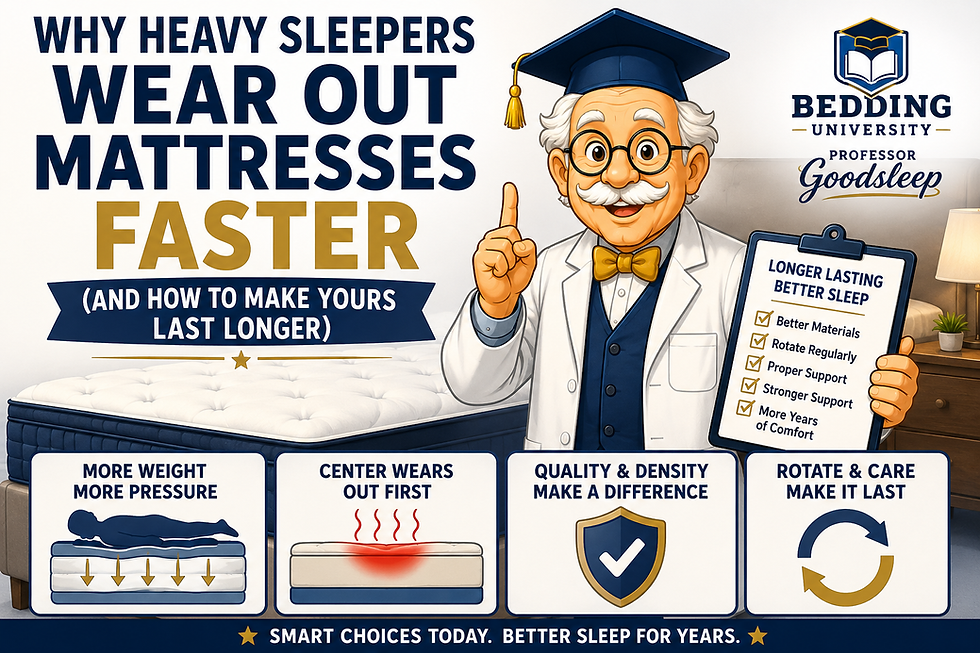
Higher body weight compresses foams more deeply.
The center third usually wears first.
Higher-density polyurethane foams generally resist wear better when comparable foam types are evaluated.
Compare hybrid, latex, and all-foam mattresses by their actual materials and construction.
Rotating your mattress may distribute wear when the manufacturer recommends it; follow the model's care instructions.
Professor Goodsleep's Lesson
Think of two identical pickup trucks. One carries groceries while the other hauls heavy loads every day. The heavier workload wears the suspension faster. Mattresses work the same way.
Why Heavy Sleepers Wear Out Mattresses Faster
Mattress materials change with use. Higher loads can compress the cushioning more deeply during repeated use, contributing to material fatigue. The result can be earlier body impressions and reduced support.

From the Sales Floor
One thing I've consistently noticed is that the center third of a mattress often shows wear first. In my sales-floor experience, this is where repeated loading under the torso and hips makes wear most noticeable.
One of my coworkers weighed close to 400 pounds, and he had a habit of sitting on the edge of the floor model mattresses while talking with customers throughout the day.
After months of doing this, something interesting happened. The sides of several floor model mattresses developed a noticeable indentation long before the rest of the mattress showed any wear and had to be replaced.
The pattern was consistent with hundreds of hours of concentrated weight in the same spot gradually compressing the comfort layers.
It was a great reminder that mattresses don't wear out evenly. They wear out where the greatest pressure is applied over the longest period of time.
That example involved prolonged, repeated sitting on showroom edges. Briefly sitting to get into or out of bed is normal use; it should not automatically be treated as misuse. If you spend long periods sitting on the bed, consider edge stability and the manufacturer's intended-use guidance.
Foam Density Matters
Many shoppers focus only on firmness. Firmness describes resistance to compression; density is a separate property that can help assess durability when comparing similar polyurethane foams. Ask which layer and foam type a density number describes. Conventional polyurethane foam, memory foam, and latex should not be ranked by one shared density cutoff.
For the underlying material properties, see the Polyurethane Foam Association's foam reference
Look Beyond the Mattress Category
A hybrid's coil unit is one part of its construction. The cushioning above it still matters. Compare the comfort materials and support system rather than assuming every hybrid will outlast every all-foam mattress.
How to Make Your Mattress Last Longer
Rotate head-to-foot only as permitted and recommended for your model.
Avoid prolonged loading in one small area when practical.
Invest in quality materials.
If a dip appears, inspect the frame, slats, and center support before blaming the mattress. Follow the exact foundation requirements and warranty measurement instructions for your model. A visible indentation, normal settling, and softening under load are different issues.
Care requirements vary: Tempur-Pedic describes rotation as optional
Signs to Investigate Before Replacing Your Mattress
New discomfort alongside a noticeable change in the bed's support.
Deep or uneven body impressions that affect comfort.
Noticeable loss of support.
Morning pain alone does not prove that a mattress needs replacing. Consider whether support has changed and whether correcting the foundation resolves the problem. Persistent or worsening pain deserves medical advice.
Final Thoughts
Buying a mattress isn't just about how it feels in the showroom. For heavy sleepers, material quality, support, and durability are critical to years of comfortable sleep.
If you are ready to compare replacement mattresses after checking the construction, start the free mattress consultation for 3–5 instant mattress recommendations. No email required.
Don't Worry, Sleep Happy.
Professor Goodsleep
Related Articles:



Comments