

Best Mattress Firmness for Back Pain: Complete Guide

Updated: 4 days ago

If you wake up with an aching back that eases after you get moving, your mattress may be contributing to the problem. But the answer is rarely as simple as buying the firmest bed in the store. A mattress can be too hard to follow your body’s curves, too soft to hold your hips level, or simply worn out enough that it no longer supports you the way it once did.
After more than a decade helping people compare mattresses, I have seen the same mistake repeatedly: shoppers confuse firmness with support. Firmness describes how hard or soft the surface feels. Support describes how well the mattress holds your spine in a neutral position for your body, weight, and sleep position.
The goal is not the firmest mattress. The goal is the mattress that keeps your spine neutral while allowing your muscles to relax.
The Quick Answer: What Firmness Is Usually Best for Back Pain?
For many adults with nonspecific back pain, a medium to medium-firm mattress is the most sensible starting point. That is a starting range, not a universal prescription. A 130-pound side sleeper and a 280-pound stomach sleeper can lie on the same mattress and experience completely different support.
Back sleepers: usually need medium to medium-firm support that holds the hips up while filling the curve of the lower back.
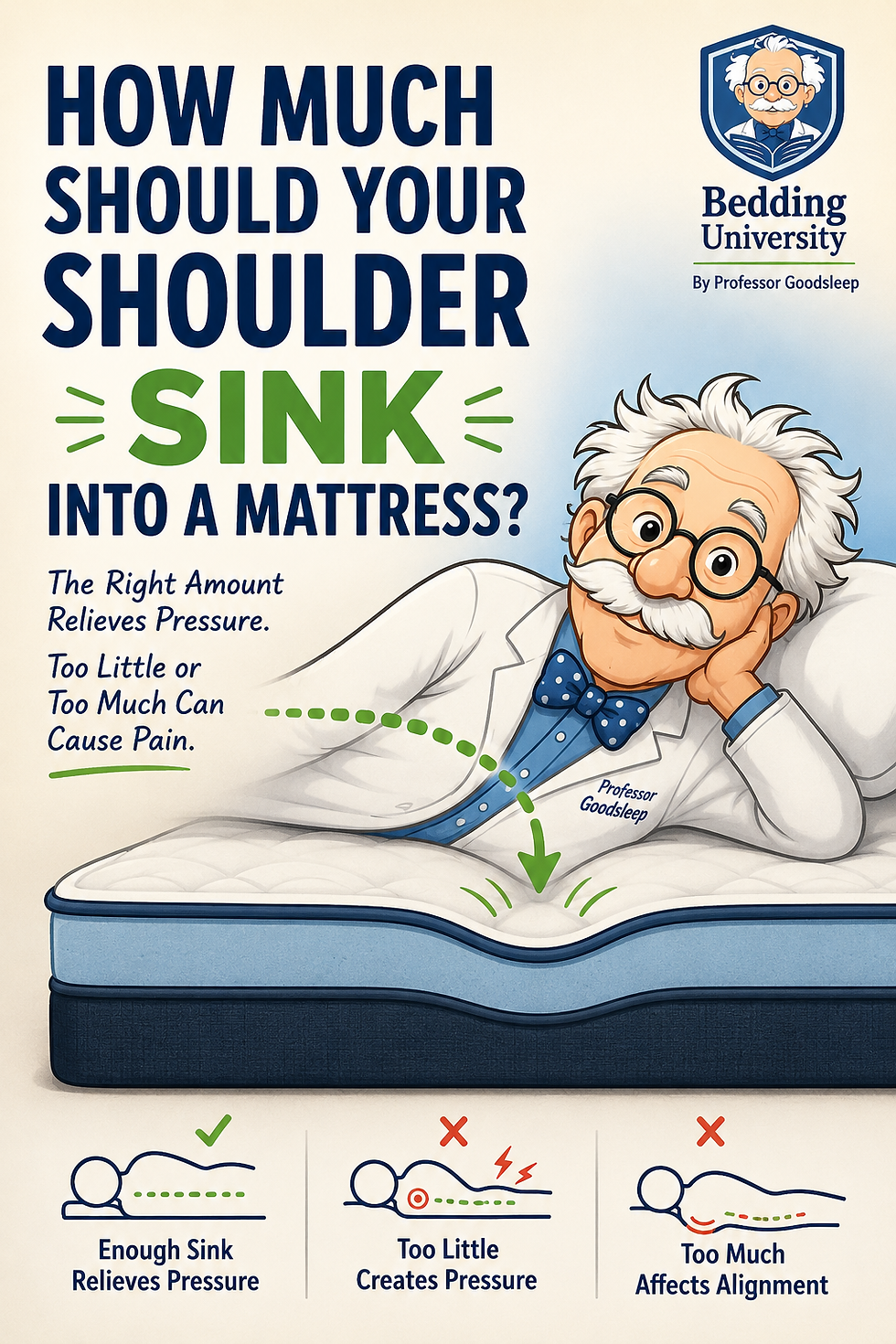
Side sleepers: often need a little more pressure relief so the shoulder and hip can sink enough to keep the spine level.
Stomach sleepers: generally need a firmer, more supportive surface to stop the pelvis from dropping and over-arching the lower back.
Heavier sleepers: usually need stronger support layers and durable coils or foams, even when they prefer a plush surface feel.
Could your mattress be contributing to the problem?
If pressure, firmness or poor support may be involved, answer a few questions and see which mattresses better fit your body and sleeping position.
Free • About 2 minutes
What the Research Actually Says
The old advice that everyone with back pain should sleep on a hard mattress does not hold up well. In a randomized, double-blind trial involving 313 adults with chronic nonspecific low-back pain, participants assigned a medium-firm mattress reported better pain and disability outcomes than those assigned a firm mattress. You can review the study on PubMed.
A later systematic review of controlled mattress studies also concluded that medium-firm and self-adjusted sleep surfaces generally performed best for comfort, sleep quality, and spinal alignment. That does not mean every person needs the same firmness number. It means harder is not automatically healthier.
Support and Firmness Are Not the Same Thing
A well-built mattress can feel plush on top and still support the spine underneath. The comfort layers relieve pressure at the shoulders, hips, and lower back. The support core—usually coils or dense foam—prevents the heavier parts of the body from sinking too far.
This is why pressing down on a mattress with your hand tells you almost nothing. Your hand cannot reproduce your body weight, spinal shape, sleep position, or what happens after several hours. The mattress has to support the whole person, not pass a palm-pressure test.

How a Mattress That Is Too Firm Can Hurt Your Back
When a mattress is too firm for your body, it may hold the shoulders and hips on top of the surface instead of letting them settle naturally. That can leave a gap beneath the lumbar area for back sleepers or bend the spine sideways for side sleepers. Your muscles may stay partially engaged all night trying to stabilize a position the mattress is not supporting.
A noticeable gap or unsupported feeling beneath the lower back
Pressure at the shoulders or hips
Numbness or tingling caused by concentrated pressure
Frequent position changes because no position feels relaxed
Morning stiffness that improves as you begin moving
How a Mattress That Is Too Soft Can Hurt Your Back
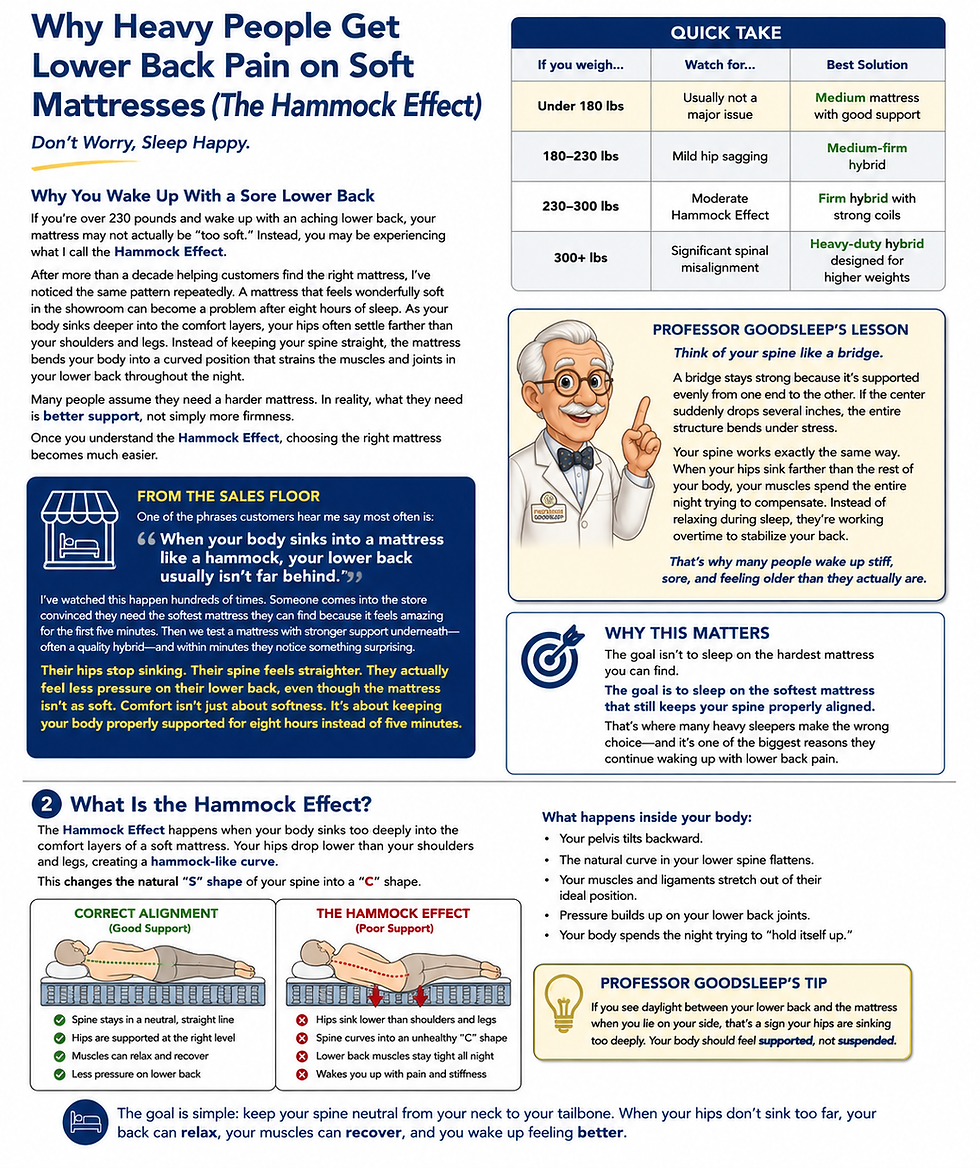
A mattress can feel wonderfully comfortable for the first five minutes and still fail after several hours. If the pelvis and midsection sink much farther than the shoulders and legs, the spine curves like a hammock. The lower-back muscles then work through the night instead of recovering.
This is especially common for larger bodies or on mattresses with weakened comfort layers. My detailed guide to the Hammock Effect for heavier sleepers explains why the real problem is inadequate support—not softness by itself.
Your hips feel trapped lower than the rest of your body
Rolling over or getting out of bed requires extra effort
The mattress has visible body impressions or sagging
The bed felt supportive when new but has gradually become less stable
Lower-back pain is strongest upon waking
Choose by Sleep Position
Back Sleepers
The mattress should support the natural curve of the lower back without letting the hips sink deeply. If you can slide a large gap beneath your lumbar area, the surface may be too firm or may not contour enough. A pillow under the knees can reduce tension for some back sleepers, but it should not be used to disguise a mattress that is clearly sagging.
Side Sleepers
Your shoulder and hip must sink enough for the spine to remain straight from the neck through the tailbone. A surface that is too firm pushes those pressure points upward. A surface that is too soft lets the pelvis collapse downward. The right mattress balances pressure relief with enough support to keep the waist and midsection from bowing.
Stomach Sleepers
Stomach sleeping is usually the hardest position on the lower back because it encourages the pelvis to drop and the lumbar spine to arch. A medium-firm to firm mattress often works better here, but body weight still matters. If back pain continues, changing position may help more than chasing an even firmer mattress.
Body Weight Changes How Firmness Feels
Mattress labels are not objective measurements. Lighter people compress the comfort layers less and often experience the same bed as firmer. Heavier people sink deeper and rely more heavily on the support core. That is why online firmness scores should be treated as comparison tools, not universal truths.
Under about 150 pounds: may need a slightly softer surface to receive enough contouring and pressure relief.
About 150–220 pounds: often falls near the advertised feel, with sleep position making the largest difference.
Over about 220 pounds: usually benefits from stronger coils, denser foams, or a design built to resist deeper sagging.
Do Zoned Support Systems Help?
Zoned support uses firmer coils or denser foam through the center portion of the mattress, where the hips and lumbar region usually carry more weight. Done well, zoning can help prevent the pelvis from sinking too far. Done poorly, it can feel like a hard ridge under a lighter person or place support in the wrong area for a very tall or short sleeper.
Treat zoning as one useful design feature—not proof that a mattress will automatically solve back pain. Your body still has to line up with the zones.
Which Mattress Type Is Best for Back Pain?
Hybrid Mattresses
A good hybrid combines individually wrapped coils with foam or latex comfort layers. The coils provide stable support and easier movement, while the upper layers fill the body’s curves and reduce pressure. This balance makes hybrids a strong starting category for many people with back pain.
Memory Foam Mattresses
Memory foam can contour closely and distribute pressure well, but the support base must be strong enough to prevent the hips from sinking too deeply. Slow-response foam can also make turning more difficult for people with limited mobility.
Latex Mattresses
Latex is buoyant, durable, and responsive. It tends to hold the body more on top of the surface while still contouring. That can work well for sleepers who need pressure relief but dislike feeling stuck in slow-moving foam.
Traditional Innerspring Mattresses
A basic innerspring can provide solid support, but thin comfort layers may create pressure points. Construction quality matters more than the category name. No mattress type is automatically best simply because it contains coils, foam, or latex.
The Mattress CPR Test Tells You Almost Nothing
It has always amazed me to watch people walk through a showroom pushing down on mattresses as though they are performing CPR. That does not bring the mattress to life, and it does not tell you whether your spine will remain aligned for eight hours.

Lie down in the position you actually sleep in. Give the comfort layers time to respond. If you share the bed, test it with your partner beside you because the weight distribution may change. A useful showroom test should last at least 10–15 minutes on the finalists—not 30 seconds on every bed in the store.
A Better 15-Minute Mattress Test
Start in your normal sleep position. Do not test only on your back if you spend most of the night on your side.
Check alignment. For side sleeping, have someone look from behind; the spine should appear reasonably level rather than dipping or arching.
Scan for pressure. Notice whether the shoulders, hips, or lower back feel jammed, unsupported, or pushed upward.
Roll over. Make sure you can change positions without fighting the mattress.
Stay long enough. Some foams soften and contour over several minutes, so the first impression may not be the final feel.
Use the sleep trial. A showroom test narrows the field; several full nights reveal whether the mattress truly works.
A Real Example: Support Without Rock-Hard Firmness
My friend Scooter had undergone an L4–L5 spinal fusion and believed he needed an extra-firm mattress. He was sleeping only four to five hours and often woke with enough pain that he kept Icy Hot beside the bed. After moving to a supportive firm hybrid with contouring memory foam, he began sleeping seven to eight hours much more consistently. Read the full lower-back-pain case study for the complete story.
His experience does not prove that one mattress will treat every back condition. It does demonstrate the distinction shoppers often miss: he still needed strong support, but he also needed enough contouring to reduce pressure and allow his body to relax.
Common Mattress-Buying Mistakes When Your Back Hurts
Buying the hardest bed available because firmness sounds like support
Ignoring body weight and sleep position
Judging the mattress only by how soft the top feels
Testing with a hand instead of lying down
Buying a new mattress when the foundation or adjustable base is the actual problem
Keeping a visibly sagging mattress because it still feels comfortable at bedtime
Expecting a mattress to diagnose or cure a medical condition
Your Pillow and Foundation Matter Too
The mattress, pillow, and foundation work as one sleep system. A pillow that holds the head too high or lets it fall too low can pull the neck and upper spine out of alignment. A broken, bowed, or widely spaced foundation can make even a good mattress sag through the center.
Before replacing the mattress, inspect the support underneath it. If the bed frame has inadequate center support or the foundation is damaged, changing the mattress alone may not solve the problem.
When Back Pain Needs Medical Attention
A mattress can influence comfort and alignment, but back pain also has many medical causes. Seek professional evaluation when pain is severe, persistent, follows a significant injury, travels down the leg, or occurs with weakness, numbness, difficulty walking, fever, unexplained weight loss, or changes in bowel or bladder control. MedlinePlus lists additional warning signs.
This article is educational and is not a diagnosis or a substitute for care from a physician or physical therapist.
Frequently Asked Questions
Is a firm mattress good for a bad back?
Not automatically. Many adults with nonspecific back pain do better starting near medium to medium-firm because the mattress must support the spine while still following the body's curves.
Can a mattress be too firm and cause back pain?
Yes. A mattress that is too firm for your body can leave the lower back unsupported, concentrate pressure at the shoulders or hips, and keep muscles working to stabilize your position.
Can a soft mattress cause lower-back pain?
A soft mattress may contribute when the pelvis and midsection sink much farther than the shoulders and legs. The problem is inadequate support and alignment, not softness by itself.
What mattress firmness is best for side sleepers with back pain?
Side sleepers generally need enough cushioning for the shoulder and hip to sink while the waist and pelvis remain supported. Body weight and shoulder-to-hip shape determine whether that lands closer to medium-soft, medium, or medium-firm.
Professor Goodsleep’s Bottom Line
Most people with back pain do not need the firmest mattress. They need the correct balance of pressure relief and support for their body weight and sleep position. Start near medium to medium-firm, then pay attention to spinal alignment, hip depth, pressure points, ease of movement, and how your back feels after a full night—not just during the first few minutes.
If your pain is mainly caused by a mattress that is too hard, too soft, worn out, or poorly supported underneath, the right sleep surface can make a meaningful difference. If the symptoms are persistent or neurological, the mattress should be only one part of a larger medical conversation.
If you are also shopping for a mattress and weighing firmness against cushioning, the free mattress consultation gives you 3–5 mattress recommendations instantly, with no email required.
Don’t Worry, Sleep Happy.
Professor Goodsleep


Comments