

Do Mattress Toppers Work? Benefits, Limits & Fit

Updated: 4 days ago
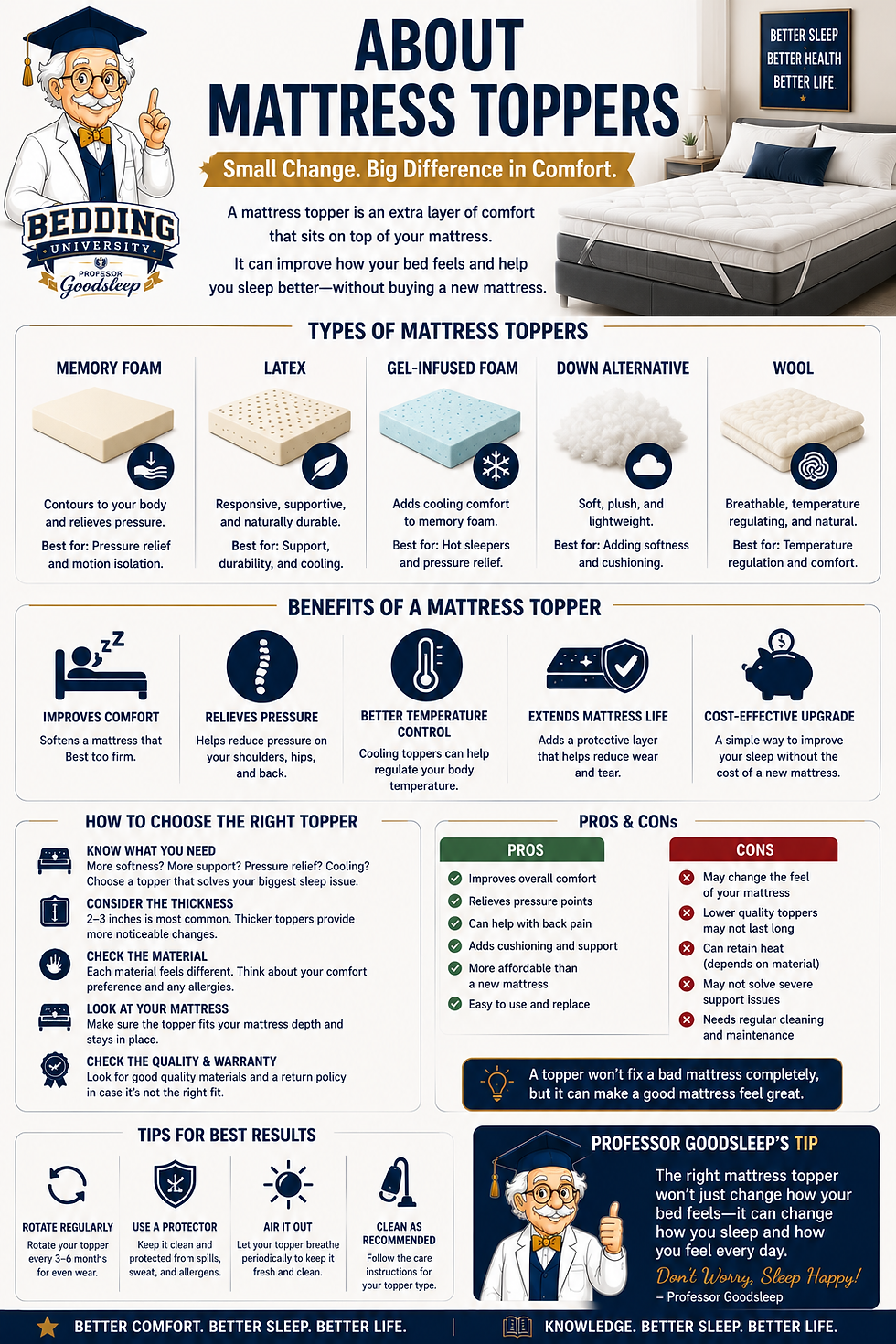
Many shoppers see mattress toppers as a quick fix for an uncomfortable bed. Sometimes they help. Other times, they simply hide a bigger problem. Knowing when a topper makes sense—and when it doesn’t—can save you money and frustration.
What a Mattress Topper Is (and Isn’t)
A topper is a separate layer, usually 1–4 inches thick, that sits on top of your mattress. It can:
Add softness or cushioning
Slightly change the feel of your bed
Fine-tune pressure relief at the shoulders and hips
But a topper cannot fix a mattress that is worn out, sagging, or broken down in the support layers. A topper will conform to whatever surface it is on, so a sagging mattress will be a softer sagging mattress.
When a Topper Can Help
A topper may be a smart choice if:
Your mattress is too firm, but still in good shape.
You wake up with sore shoulders or hips from pressure points.
You’re not ready to replace a fairly new mattress, but want a softer feel.
You’re sleeping on a guest bed or dorm mattress that feels hard but not saggy.
In these cases, a topper can add comfort without replacing the entire mattress.
When a Topper Is the Wrong Solution
A topper is usually not the answer if:
Your mattress has visible sagging or body impressions.
You roll toward the middle or feel like you’re stuck in a dip.
You wake up with back pain that improves when you sleep elsewhere.
Putting a topper on a sagging mattress is like putting a soft pad on a broken foundation. It may feel better for a short time, but it doesn’t solve the real problem: worn-out support.
Common Topper Materials
Memory foam:
Good for pressure relief and contouring.
Can sleep warmer, depending on the foam and cover.
Latex:
More responsive and bouncy.
Often sleeps cooler and feels more “on” the bed than “in” it.
Fiberfill or down/alternative:
Adds a plush, pillow-top feel.
Less support, more about surface softness.
Choose based on what you’re trying to change: pressure relief, bounce, or simple plushness.
Thickness: How Much Is Too Much?
1–2 inches:
Good for small adjustments in comfort.
Best if your mattress is close to what you want, but slightly too firm.
3–4 inches:
Makes a bigger change in feel.
Can help side sleepers who need more cushioning at shoulders and hips.
If you go too thick on a soft base, you may lose support and end up with more back pain.
Watch Your Sheet Fit
A thick topper adds height to your bed. Make sure:
Your fitted sheets have deep pockets.
The topper doesn’t slide around on the mattress.
Some toppers include straps or a grippy bottom to help keep them in place.
Final Thoughts
A mattress topper is best used as a fine-tuning tool, not a bandage for a worn-out bed. If your mattress is still supportive but feels too firm or a bit unforgiving, a topper can be a smart, budget-friendly upgrade. If the mattress is sagging or causing daily pain, your money is usually better spent on a new mattress instead of another layer on top.
If you have decided to compare new mattresses instead of adding a topper, the free mattress consultation gives you 3–5 mattress recommendations instantly, with no email required.
Don't worry, Sleep Happy.
Professor Goodsleep



Comments