

How Cooling Mattresses Work: The Science Explained

Updated: 4 days ago

Quick Answer
Cooling mattresses do not create cold air. Passive designs manage heat through airflow, lower heat retention, moisture movement, thermal conductivity, or short-term heat absorption. The strongest all-night control comes from active powered systems that circulate air or water. For most shoppers, the best passive choice is a breathable hybrid or latex mattress paired with breathable bedding and a comfortable bedroom environment.
Technology | What it can do | Main limitation |
Coil airflow | Creates open channels through the support core | Thick foam above can still trap heat |
Latex | Responds quickly and is often less enveloping | Softness and construction still matter |
Cool-touch cover | Feels cooler at first contact | Surface approaches body temperature |
Phase-change material | Buffers heat by absorbing thermal energy | Capacity is finite |
Gel, graphite, copper | May spread heat through foam | Does not remove heat from the room |
Active system | Circulates air or water | Adds cost, power, noise, or maintenance |
Trying to turn cooling-mattress claims into a useful shortlist? The free mattress consultation gives you 3–5 mattress recommendations instantly, with no email required.
Why Temperature Affects Sleep
Sleep and thermoregulation are closely connected. Core body temperature begins to fall before sleep, and excessive heat exposure can increase wakefulness. Reviews from NIH and PubMed support the broader point: the thermal environment can affect sleep. That does not mean one exact room temperature or one mattress technology is best for everyone.
The relevant zone is the bed microclimate—the small space between your body, mattress, sheets, and blankets. A cool room can still feel hot under heavy bedding, and a breathable mattress can be masked by a less breathable protector.
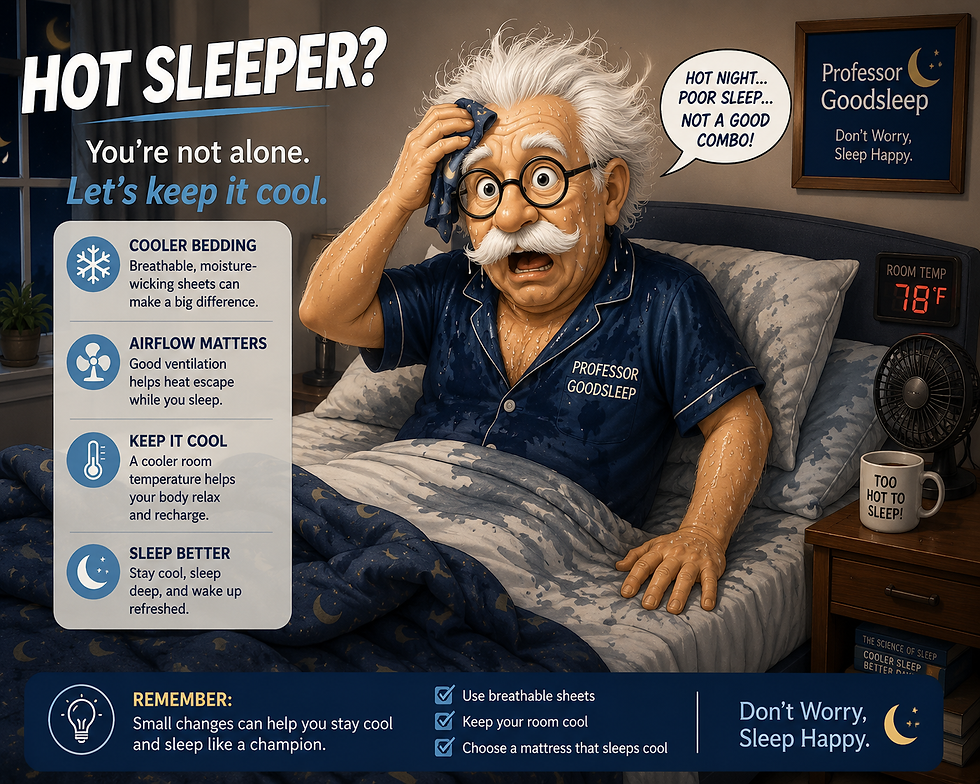
Why Some Memory Foam Feels Hot
Slow-response memory foam closely contours the body. More surface contact can reduce the open space available for air movement, and thick foam layers can hold heat near the sleeper. Density alone does not prove a mattress will sleep hot, but deeper sink and less airflow can increase the sensation.
Open-cell structure, convolutions, perforations, and a coil support core may improve airflow. The practical question is not whether a brand uses a cooling ingredient; it is whether the complete construction moves or stores enough heat to change your experience.
Airflow: The Most Reliable Passive Starting Point
Innerspring and hybrid support cores contain large open spaces compared with solid foam. That gives warm air a path to move, especially when the comfort layers are not excessively thick. Latex is also a strong option because it responds quickly and usually leaves the sleeper less deeply enveloped.
For mattress recommendations built around this principle, see the best mattress for hot sleepers guide.
Cool-Touch Covers and Phase-Change Materials
A cool-touch textile can improve the initial hand feel, but it does not have unlimited cooling capacity. Once the surface warms, performance depends on how the heat is dispersed into the rest of the mattress and surrounding air.
Phase-change materials absorb thermal energy during a phase transition and can release it later. The U.S. Department of Energy describes this principle in thermal storage. In a mattress, treat PCM as a buffer that can delay heat buildup—not a refrigerator that stays cold indefinitely.
Gel, Graphite, Copper, and Other Additives
Conductive or heat-spreading additives can move heat away from one small area and distribute it through a larger volume of foam. That may improve early-night comfort. But passive additives cannot destroy heat; the construction still needs somewhere for that energy to go.
Be skeptical of an isolated ingredient claim. Ask how thick the cooling layer is, where it sits, whether the mattress has airflow below it, and whether a protector or thick sheets will cover it.
The Rest of the Sleep System Matters
Use a breathable protector that still meets your spill and allergy needs.
Choose sheets and blankets appropriate for the season.
Avoid stacking thick pads over a cooling surface.
Keep the room comfortable and use air movement when practical.
Remember that medications, hormones, illness, and other health factors can affect temperature; discuss persistent night sweats with a healthcare professional.
Our companion guide on cooling sheets and cooling mattresses explains how bedding can help or cancel the mattress benefit.
How to Test Cooling Before You Buy
Lie in your normal position for at least 15 to 20 minutes; first-touch coolness is not the same as sustained comfort.
Test with a protector and bedding similar to what you use at home when possible.
Notice how deeply you sink and how much of your body is surrounded by foam.
Ask whether the cooling feature is passive or powered and what maintenance it requires.
Use the home trial across warm and cool nights, and read return terms before purchasing.
Professor Goodsleep’s Recommendation
Start with construction: breathable coil support or latex, moderate contour depth, and bedding that does not trap unnecessary heat. Treat cool-touch fabric and infusions as supporting features, not the whole solution. If you are an extreme hot sleeper and passive changes have failed, compare active temperature systems rather than paying repeatedly for surface-level cooling claims.
If you are ready to compare mattresses with temperature comfort in mind, use the free mattress consultation to narrow your shortlist.
Frequently Asked Questions
What mattress material usually sleeps coolest?
Latex and breathable hybrid or innerspring designs generally retain less heat than deep, slow-response memory foam. The cover, comfort-layer thickness, protector, bedding, and room conditions still affect the result.
Do cooling mattress covers work all night?
Many cool-touch covers mainly improve the first-contact sensation. Sustained comfort depends on where the absorbed heat can go after the surface warms.
What is phase-change material in a mattress?
Phase-change material is designed to absorb thermal energy as it changes state and release it later. In a thin mattress application, its effect is finite, so it should be treated as a heat-buffering feature rather than permanent refrigeration.
Does gel memory foam sleep cool?
Gel or conductive additives may help spread heat, especially early in the night, but they do not guarantee all-night cooling. Foam depth, airflow, body contact, and bedding often matter more.
Can a mattress lower the room temperature?
No. A passive mattress can manage heat near the body but cannot cool the room. Active air- or water-based systems can move heat more aggressively, but they use separate powered equipment.
Why does my mattress feel hotter with a protector?
A less breathable or waterproof protector can reduce airflow and moisture transfer. Test the full sleep system—mattress, protector, sheets, blankets, sleepwear, and room—not the mattress alone.
Don’t Worry, Sleep Happy.
—Professor Goodsleep


Comments