

Mattress Firmness for Heavy People: Complete Guide

Updated: 4 days ago
Looking for complete mattress recommendations? Read my Ultimate Guide to the Best Mattress for Heavy People for in-depth reviews, buying advice, and mattress
recommendations for every body type.
Quick Answer
• Quick Answer
• Why Firmness Feels Different for Heavy People
• Why Heavy People Often Sleep Hotter
• From the Sales Floor: The Hammock Effect
• Medium-Firm vs. Firm
• Sleeping Position Changes Everything
• Why Construction Matters More Than Firmness
• Common Mistakes Heavy Sleepers Make
• Professor Goodsleep's Advice
• Frequently Asked Questions
• Related Reading
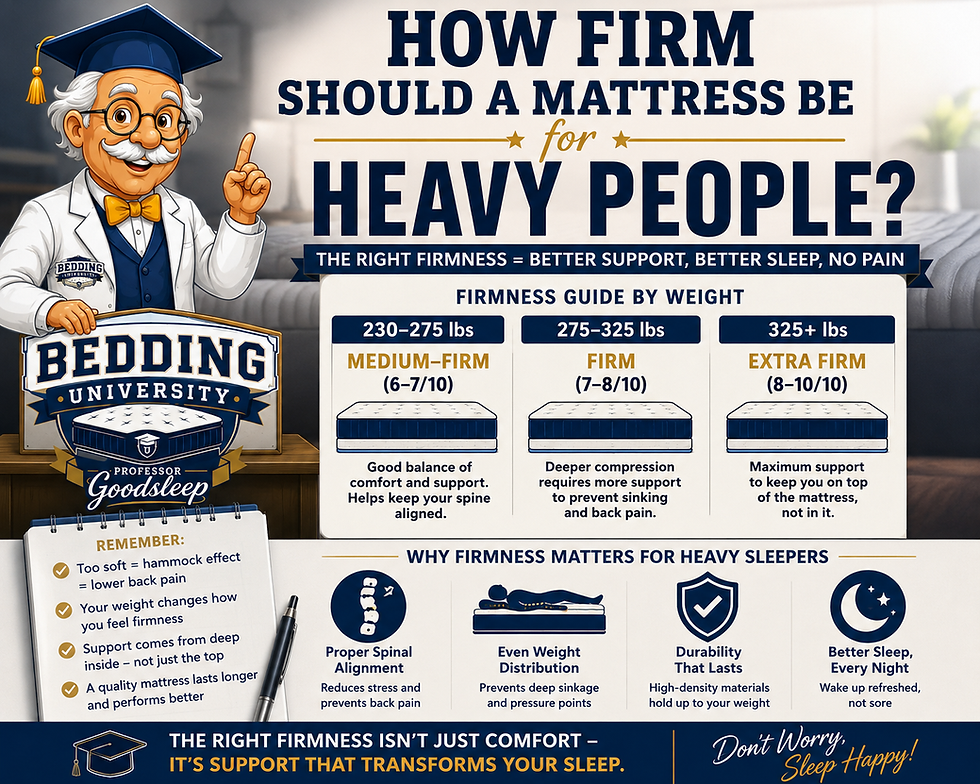
Weight | Recommended Feel |
230–275 lbs | Medium-Firm |
275–325 lbs | Firm |
325+ lbs | Firm with reinforced support |
If you weigh more than 230 pounds, a medium mattress often won't feel like a true medium. Heavier sleepers generally do best on a quality medium-firm to firm mattress with strong support, but sleeping position and body shape still matter.
If you're over 230 pounds, don't choose a mattress based on firmness alone. Construction quality, coil support, and foam density are just as important as the firmness rating.
Comparing mattress firmness with your body size and sleep position in mind? Build a shortlist with the free mattress consultation: 3–5 mattress recommendations instantly, with no email required.
Why Firmness Feels Different for Heavy People
Body weight changes how deeply you compress the comfort layers. A mattress that feels firm to someone weighing 170 pounds may feel much softer to someone weighing 275 pounds. The goal isn't the hardest mattress—it's keeping your spine in a neutral position all night.
Why Heavy People Often Sleep Hotter
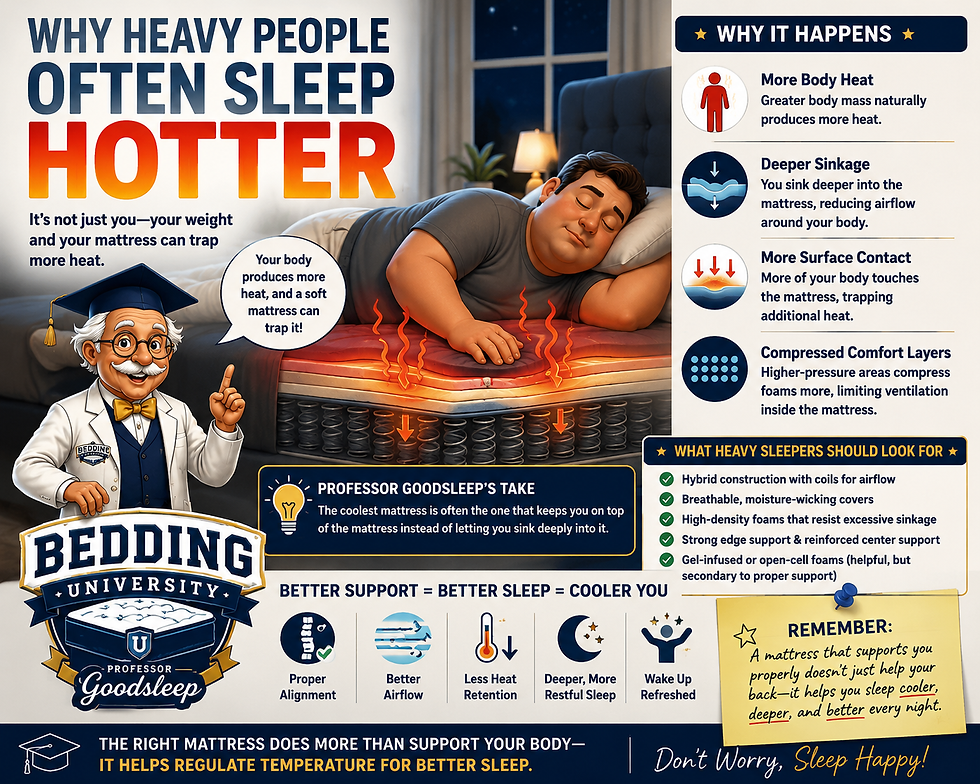
One issue many heavier sleepers don't expect is that they often sleep warmer than lighter people.
Why It Happens
Greater body mass naturally produces more heat. You sink deeper into the mattress, reducing airflow around your body. More of your body is in contact with the mattress, trapping additional heat. Higher-pressure areas compress foams more, limiting ventilation inside the comfort layers.
I've seen this many times on the sales floor. A customer may tell me they wake up hot every night, but the real issue isn't always the mattress materials—it's that they're sinking so deeply into the bed that air simply can't circulate around them.
What Heavy Sleepers Should Look For
Hybrid construction with coils instead of all-foam.
Breathable covers.
High-density foams that resist excessive sinkage.
Strong edge support and reinforced center support.
Gel-infused or open-cell comfort foams (helpful, but secondary to proper support).
Key Insight: The coolest mattress is often the one that keeps you on top of the mattress instead of letting you sink deeply into it.
Professor Goodsleep's Take
Support and temperature work together. When a mattress is too soft, heavier sleepers usually sink farther into the comfort layers. That creates the "hug" many people enjoy for a few minutes—but it also traps body heat and can leave you waking up hot, sweaty, and uncomfortable.
From the Sales Floor: The Hammock Effect
For heavier sleepers, the softest mattress often feels great at first—but it can quickly turn into a back pain trap.
When someone is heavy enough to sink deeply into a mattress, the bed can begin to act like a hammock. The hips sink farther than the shoulders and legs, causing the spine to bow instead of staying in a neutral position.
Imagine sleeping in a hammock all night. It might feel relaxing for a few minutes, but after eight hours your lower back probably won't thank you. I've seen the same thing happen with mattresses.
Many people assume the mattress is simply too soft, but the real issue is that it no longer provides enough support to keep the spine aligned. As the hips continue sinking night after night, extra stress is placed on the lower back, often leading to stiffness or pain when you wake up.
That's why I rarely recommend the softest mattress for heavier sleepers. A quality medium-firm or firm mattress should provide enough cushioning for comfort while preventing your hips from sinking too deeply.
Another important factor I often discuss with heavier customers is breathing during sleep. Carrying extra weight can increase the likelihood of snoring or sleep apnea. An adjustable base that slightly elevates the head can help keep the airway more open and may improve sleep quality for some people.
Professor Goodsleep's Tip: If you feel like you're sleeping in the mattress instead of on it, and you wake up with lower back pain, your mattress may no longer be supporting your body weight properly.
Medium-Firm vs. Firm
Medium-firm is often best for side sleepers and combination sleepers between 230 and 275 pounds. Firm mattresses are often better for back sleepers, stomach sleepers, and people over 275 pounds who need additional support.
Quick Mattress Recommendations by Weight and Sleeping Position?
If You... | Recommended | Why |
Side sleeper (230–275 lbs) | Medium-Firm | Better pressure relief without excessive sinkage |
Back sleeper | Firm | Keeps the spine aligned |
Stomach sleeper | Firm | Prevents hips from dropping |
325+ lbs | Firm with reinforced support | Maximum durability and support |
Sleep hot | Firm Hybrid | Better airflow and less heat retention |
Remember: Firmness is only part of the equation. A well-built medium-firm hybrid often provides better long-term support than a cheaper mattress that's simply labeled "Firm."
Sleeping Position Changes Everything
Side sleepers need more pressure relief, back sleepers need better lumbar support, and stomach sleepers generally need the firmest support to prevent the hips from dropping.
Why Construction Matters More Than Firmness
Two mattresses can both be labeled 'firm' while performing very differently. Look for high-density foams, zoned support, pocketed coils, reinforced edges, and durable construction.
Many shoppers assume that a firm mattress automatically provides better support. In reality,
construction matters far more than the label. A well-built hybrid with high-density foams, reinforced coils, and zoned lumbar support will usually outperform a cheaper mattress that simply feels firm in the showroom. The goal is lasting support—not temporary firmness.
What to Look for Before Buying
Feature | Why It Matters |
High-density foam | Resists sagging longer |
Pocketed coils | Better support and motion isolation |
Reinforced center support | Supports the heaviest part of your body |
Reinforced edges | Easier to get in and out of bed |
Hybrid design | Better airflow and durability |
Zoned support | Extra lumbar support where you need it most |
Common Mistakes Heavy Sleepers Make
Choosing the softest mattress in the showroom
Ignoring support construction
Assuming all firm mattresses feel the same
Forgetting that mattresses soften during the break-in period

If you would like a mattress shortlist based on the firmness and support feel you prefer, use the free mattress consultation to narrow your shortlist.
Professor Goodsleep's Advice
If there's one lesson I've learned after helping thousands of customers over the years, it's
this: heavier people shouldn't buy the softest mattress that feels good for five minutes. Buy
the mattress that still feels good after eight hours—and still supports you five years from
now. That's the difference between comfort today and better sleep for years to come.
Frequently Asked Questions About Mattress Firmness for Heavy People:
Is a medium-firm mattress good for a 300-pound person?
Usually not. Most people around 300 pounds get better long-term support from a quality firm hybrid mattress with reinforced coils. Side sleepers may still prefer a medium-firm feel if the mattress has excellent support underneath.
Can a mattress be too firm?
Yes. A mattress that's too firm can create pressure points in the shoulders and hips, especially for side sleepers. The goal isn't the firmest mattress—it's the mattress that keeps your spine in a neutral position.
Do heavy people wear out mattresses faster?
Generally, yes. Greater body weight compresses foams and coils more, so durability becomes much more important. High-density foams and reinforced support systems typically last longer.
Is memory foam good for heavy sleepers?
It can be, especially in a hybrid mattress with strong coil support. Dense memory foam provides pressure relief, but an all-foam mattress may retain more heat and allow deeper sinkage.
Why do heavy people sleep hotter?
Heavier sleepers naturally generate more body heat and often sink deeper into the mattress, reducing airflow. A supportive hybrid mattress usually sleeps cooler because it keeps you more elevated.
How long should a mattress last for a heavy person?
A high-quality hybrid mattress often lasts 7–10 years, while lower-quality foam mattresses may lose support much sooner under heavier body weights.
Related Reading
For a complete buying guide, read 'Best Mattress for Heavy People: 2026 Ultimate Buyer's Guide.' It explains mattress construction, durability, foam density, zoned support, and how to choose the right mattress for your body weight.
Don't Worry, Sleep Happy.
Professor Goodsleep
Related Articles:



Comments