

Best Mattress for Side Sleepers: Pressure Relief Without Losing Support

Updated: 4 days ago
Quick Answer
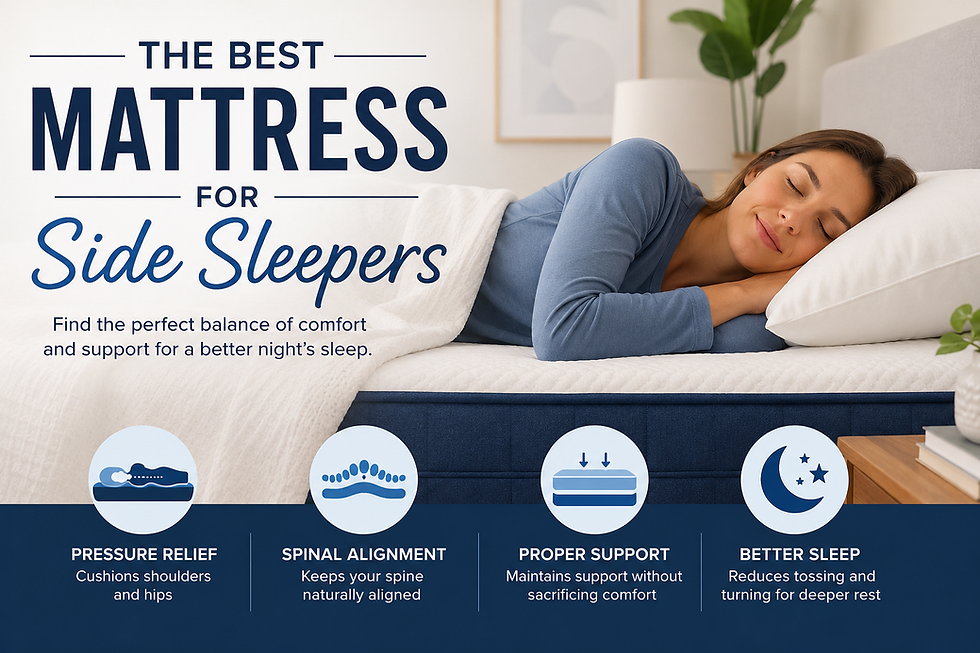
Most side sleepers need a mattress that lets the shoulder and hip sink in without allowing the waist or pelvis to collapse. That usually means medium-soft to medium at the surface, supported by a stable transition and support system.
The best starting point changes with body weight, shoulder width, hip shape, pain history, and whether you prefer the slow contour of memory foam or the easier movement of a hybrid or latex mattress.
Looking for a mattress shortlist for side sleeping? Use the free mattress consultation to get 3–5 mattress recommendations instantly, with no email required.
Why Side Sleepers Feel Pressure So Quickly
When you lie on your side, much of your body weight is concentrated into the shoulder and hip. Try lying on a hard floor for several minutes and the pressure becomes obvious. A mattress spreads that load across a larger area, but a mattress that is too firm can still create the same problem more slowly.
If the shoulder cannot sink enough, it gets pushed upward and the neck may tilt away from neutral alignment. If the hip cannot settle, the lower back may twist. If the mattress is too soft, the pelvis may sink farther than the ribs and legs. Side-sleeper comfort is a balance—not a contest to find the softest mattress.
Firmness Starting Points by Body Type
Sleeper Profile | Useful Starting Feel | Main Concern |
Lighter side sleeper | Soft to medium-soft | Enough compression to activate pressure relief |
Average-weight side sleeper | Medium-soft to medium | Shoulder and hip relief with waist support |
Heavier side sleeper | Supportive medium to medium-firm | Durable depth without bottoming out |
Broad shoulders or prominent hips | More conforming surface | Room for curves without spinal twist |
Side and back combination sleeper | Responsive medium | Pressure relief plus easy repositioning |
Firmness labels are inconsistent between brands. Use the complete Mattress Firmness Guide to translate labels into how a mattress is likely to feel under your body.
My Experience as a Broad-Shouldered Side Sleeper
I have relatively broad shoulders compared with my hips. A mattress that feels perfectly medium to someone with a narrower build can feel too firm to me because my shoulder has farther to travel before my spine levels out. Over the years, I have generally done best on the softer side of medium—provided the mattress still has a durable support system underneath.
Three Strong Construction Starting Points
Construction | Why Side Sleepers Like It | Watch For |
Pressure-relieving memory foam | Deep contouring and strong motion isolation | Heat and slower movement |
Pressure-relieving hybrid | Contour plus coils, edges, airflow, and mobility | A firm top can cancel the benefit |
Plush Talalay latex | Responsive pressure relief without a stuck feeling | Buoyant feel and higher price |
Firsthand Mattress Examples
TEMPUR-ProAdapt Medium Hybrid: A reliable reference point for slow, even pressure relief with a true medium feel in my testing.
Helix Midnight Elite: A strong premium-hybrid example for side sleepers who want pressure relief, airflow, easier movement, and a more traditional mattress response.
Plush Talalay latex: A useful option for people who want cushioning and mobility without the deep memory-foam sink.
These are starting points, not universal winners. A mattress can be well built and still be the wrong firmness for your shoulders, hips, or movement preferences.
Signs the Mattress Is Too Firm
Shoulder or hip soreness that builds during the night
Frequent repositioning after initially feeling comfortable
Pins-and-needles or pressure-related arm symptoms
A visible gap beneath the waist
Feeling as though the shoulder is being pushed toward the ear
Signs the Mattress Is Too Soft
The pelvis sinks noticeably lower than the ribs and legs
Lower-back tightness develops after several hours
Turning over requires effort
You feel trapped in a deep body impression
The mattress feels supportive at first but collapses through the comfort layer
Shoulder Width Matters as Much as Scale Weight
Two people can weigh the same and need different mattresses. Shoulder-to-hip proportions change how far the body must sink to reach neutral alignment. Read How Much Should Your Shoulder Sink Into a Mattress? for a practical way to evaluate this.
Arm Numbness Requires Some Caution
A firmer surface can increase pressure on the shoulder and arm, but a mattress is not the only possible cause. Pillow height, sleeping posture, nerve irritation, and medical conditions can contribute. The guide to arm numbness while sleeping explains the mattress-related possibilities and when symptoms should not be dismissed.
How to Test a Mattress as a Side Sleeper
Settle into your normal side-sleeping position for at least several minutes.
Check whether the shoulder feels compressed or relaxed.
Ask whether your waist is supported rather than hanging in a gap.
Notice whether the pelvis drops much lower than the rib cage.
Roll to your back and back to your side to test mobility.
Do not let a plush showroom top distract you from weak underlying support.
Use the full 10-minute mattress testing method before making a decision.
Frequently Asked Questions
What firmness is best for side sleepers?
Many side sleepers prefer a medium-soft to medium feel, but body weight, shoulder width, hip shape, and comfort-layer depth matter more than a label printed by the manufacturer.
Should side sleepers choose a soft mattress?
Not always. The mattress must relieve shoulder and hip pressure while still supporting the waist and preventing the pelvis from sinking too deeply.
Why does my arm go numb when I sleep on my side?
Direct pressure on the shoulder or arm can contribute, but numbness can also have medical causes. Persistent, worsening, or daytime symptoms deserve professional evaluation.
Is memory foam or a hybrid better for side sleepers?
Memory foam can provide excellent contouring and motion isolation. A hybrid can add airflow, edge support, and easier movement. The quality and firmness of the complete mattress matter more than the category name.
Do heavier side sleepers need a firmer mattress?
They usually need stronger underlying support and durable transition layers, but they still need enough surface pressure relief for the shoulder and hip.
Professor Goodsleep's Bottom Line
Do not buy a mattress from one specification alone. Match the construction and feel to your body, sleeping position, and the problem you are actually trying to solve.
If you are still weighing cushioning and support feel for side sleeping, use the free mattress consultation to narrow your shortlist.
Don't Worry, Sleep Happy.
Professor Goodsleep



Comments