

Why Heavy People Get Lower Back Pain on Soft Mattresses (The Hammock Effect)

Updated: 4 days ago
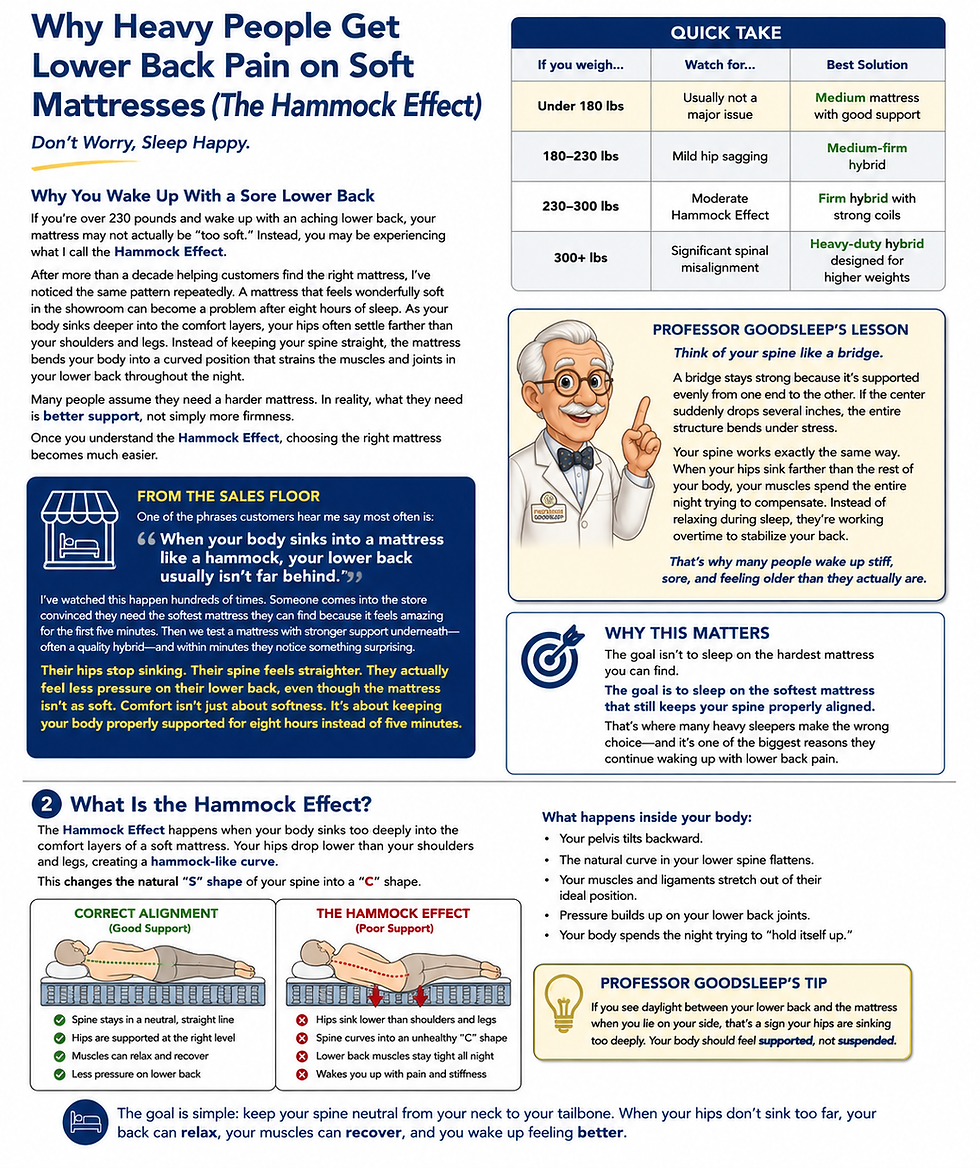
Why You Wake Up With a Sore Lower Back
If you're over 230 pounds and wake up with an aching lower back, your mattress may not actually be "too soft." Instead, you may be experiencing what I call the Hammock Effect. After more than a decade helping customers find the right mattress, I've noticed the same pattern repeatedly. A mattress that feels wonderfully soft in the showroom can become a problem after eight hours of sleep. As your body sinks deeper into the comfort layers, your hips often settle farther than your shoulders and legs. Instead of keeping your spine straight, the mattress bends your body into a curved position that strains the muscles and joints in your lower back throughout the night. Many people assume they need a harder mattress. In reality, what they need is better support, not simply more firmness.
Quick Take
Under 180 lbs: Medium mattress with good support
180–230 lbs: Medium-firm hybrid
230–300 lbs: Firm hybrid with strong coils
300+ lbs: Heavy-duty hybrid designed for higher weights
Professor Goodsleep's Lesson
Think of your spine like a bridge. When the center drops, the entire structure bends. Your spine behaves the same way. If your hips sink much farther than your shoulders and legs, the muscles in your lower back work all night to stabilize your body instead of recovering.

From the Sales Floor
One of the phrases customers hear me say most often is:
"When your body sinks into a mattress like a hammock, your lower back usually isn't far behind."
After helping customers compare mattresses, I often see their posture improve immediately when they move from an overly soft bed to a supportive hybrid. Comfort is about proper support for eight hours—not just softness during a five-minute showroom test.
Still Waking Up With Lower Back Pain?
The problem isn't always that your mattress is too soft—it may simply be losing the support your body needs. As foams wear down and support layers weaken, your hips can begin to sink farther than your shoulders and legs, creating the "Hammock Effect" and placing extra stress on your lower back.
Before spending money on a new mattress, read "When Should You Replace Your Mattress?" to learn the warning signs that your current mattress has reached the end of its useful life.
What Is the Hammock Effect?
Imagine hanging a camping hammock between two trees. The middle naturally drops lower than the ends. If you lie in it long enough, your body curves into a "U" shape. The same thing can happen on a mattress that allows your hips and midsection to sink much deeper than your shoulders and legs. For heavier sleepers, this effect is amplified because the hips and torso typically carry the greatest percentage of body weight. If the comfort layers are too soft or the support core isn't strong enough, your pelvis drops while the rest of your body remains higher. That curved sleeping posture places continuous stress on the muscles, ligaments, and joints of the lumbar spine. Even though you're asleep, your body is constantly trying to maintain stability. Over weeks or months, this can lead to morning stiffness, recurring lower back pain, tossing and turning, and the feeling that your mattress was comfortable when it was new but has become progressively less supportive. The important point is that the Hammock Effect is caused by poor spinal alignment—not simply by a mattress feeling soft. A mattress can feel plush on top while still providing excellent support underneath if it uses high-quality foams and a strong coil system.
If you are also shopping for a mattress and weighing cushioning against support feel, start the free mattress consultation for 3–5 instant mattress recommendations. No email required.
Don't Worry, Sleep Happy.
-Professor Goodsleep
Related Articles:
What Research Says About Firmness and Back Pain
Controlled mattress studies do not support the idea that harder is automatically healthier. A systematic review of mattress research found that medium-firm and self-adjusted sleep surfaces generally performed best for comfort, sleep quality, and spinal alignment.
The important distinction is whether the mattress keeps your pelvis supported without creating excessive pressure. For the complete decision process, read Best Mattress Firmness for Back Pain: A Complete Guide.



Comments