

How Much Should Your Shoulder Sink Into a Mattress?

Updated: 4 days ago
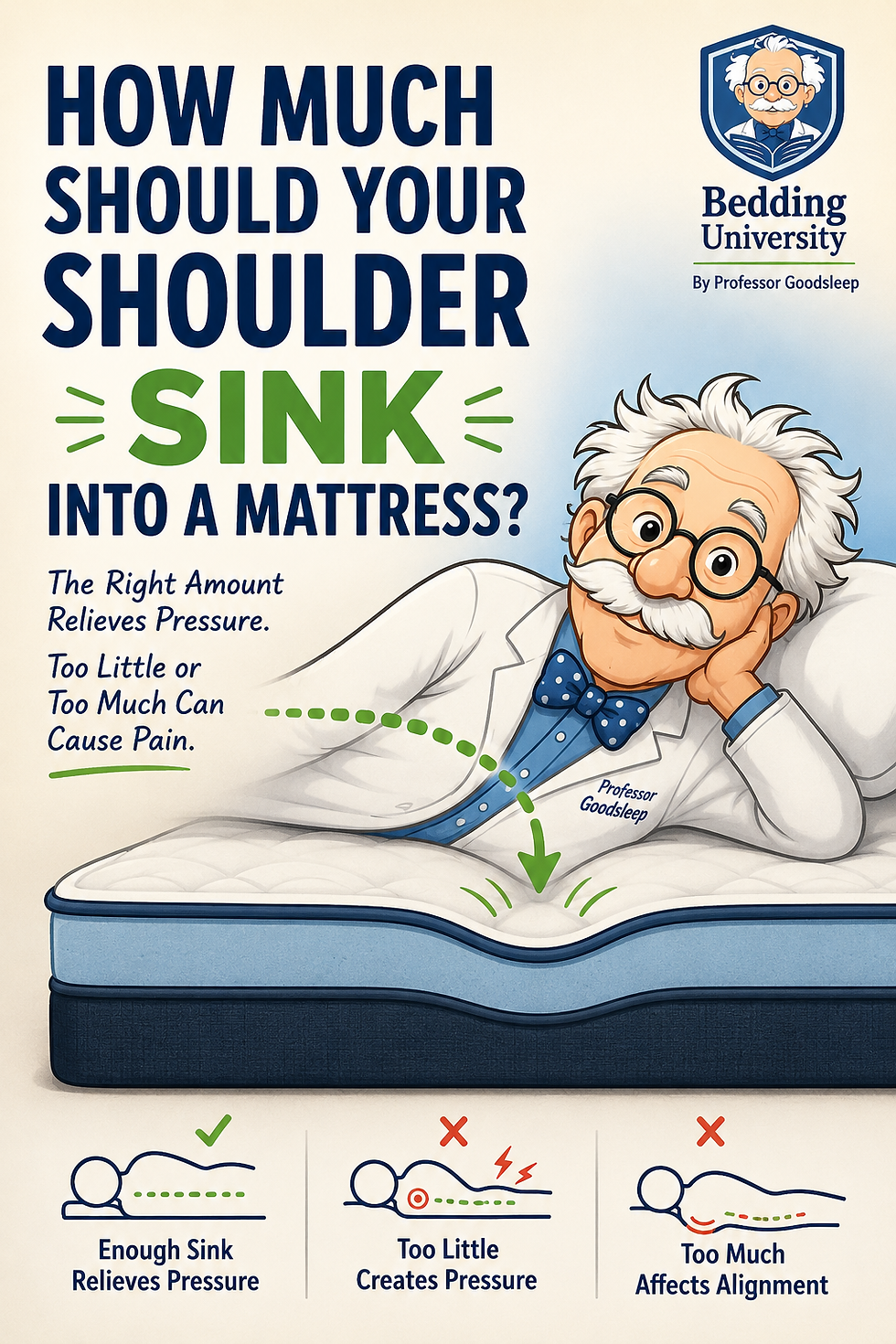
If you're a side sleeper, your shoulder needs somewhere to go.
That sounds simple, but after years of helping people test mattresses, I've found that many shoppers focus almost entirely on whether a mattress feels firm or soft. What they often overlook is something more important: Does the mattress actually give your shoulder enough room to sink in without letting the rest of your body fall out of alignment?
There is no perfect number of inches that applies to everyone. A 130-pound sleeper with narrow shoulders doesn't need the same amount of sinkage as a 250-pound sleeper with broad shoulders. Your body weight, shoulder width, waist shape, pillow, and mattress construction all affect how deeply your shoulder should settle into the mattress.
The goal isn't to sink as deeply as possible. The goal is to sink just enough.
Quick Take
Your shoulder should sink far enough into the mattress to reduce concentrated pressure and help keep your spine in a comfortable, reasonably neutral position. If your shoulder can't sink enough, you may experience shoulder pain, numbness, tingling, frequent tossing and turning, or wake up with what feels like a dead arm.
But sinking too deeply isn't necessarily better. If your torso collapses too far into the mattress, spinal alignment can suffer and movement may become more difficult. The right amount of shoulder sinkage depends on your body—not an arbitrary number of inches.
Comparing mattress cushioning for side sleeping? Build a shortlist with the free mattress consultation: 3–5 mattress recommendations instantly, with no email required.
There Is No Magic Number of Inches
People sometimes want a specific answer: Should my shoulder sink one inch? Two inches? Three inches?
The problem is that bodies aren't standardized. Consider two side sleepers. One weighs 130 pounds and has relatively narrow shoulders. The other weighs 230 pounds with a broad upper body and narrow waist. Even on the same mattress, they will compress it differently and may need completely different levels of surface conformity.
Shoulder width, waist width, body weight, weight distribution, hip width, pillow height, mattress firmness, comfort-layer thickness, and mattress material can all affect how much shoulder sinkage you need. This is why I don't believe in choosing a mattress based on firmness alone. A mattress can feel plush and still be supportive. It can also feel extremely firm while creating terrible pressure points.
Firmness and Support Are Not the Same Thing
Your Shoulder-to-Waist Gap Matters More Than Most People Realize
I understand this personally because I have broad shoulders and a much narrower waist—what I jokingly call my Johnny Bravo build. As a side sleeper, that creates a fairly large gap between my shoulder and waist. My mattress needs to let my shoulder sink in while still supporting the rest of my body. If the mattress is too firm, my shoulder takes the punishment.
For me, a mattress around a 3 out of 10 on the firmness scale can work very well because I need substantial pressure relief around my shoulders. That doesn't mean every side sleeper should choose a 3 out of 10 mattress.
The point is that body shape matters. Two people of exactly the same weight may need different mattresses simply because one has broader shoulders or a larger shoulder-to-waist gap.
Signs Your Shoulder Isn't Sinking Enough
A mattress that's too firm for your body doesn't always announce itself with immediate, sharp pain. Sometimes the symptoms develop gradually during the night. Common signs can include shoulder pain or aching, waking with a numb or dead arm, tingling in the hands or fingers, constantly switching sides, frequent unexplained awakenings, pressure building after several minutes, or needing to move your arm into unusual positions to get comfortable.
One of the most important things I've learned from watching thousands of people test mattresses is that pressure takes time to reveal itself. A mattress can feel comfortable for 30 seconds and uncomfortable after 10 minutes.
From the Sales Floor: Give It 10 to 15 Minutes
When customers test mattresses, I encourage them to stay in their normal sleeping position for at least 10 to 15 minutes whenever possible. This is especially important for side sleepers.
Your body needs time to relax. Your shoulder needs time to settle into the comfort layers. And pressure points need time to become noticeable.
I've seen customers lie down on a mattress and immediately say, “This is too soft.” Then, after 10 minutes, they realize their shoulder feels better, their body is supported, and they're actually more comfortable than they were on the firmer mattress they originally thought they needed.
One of the biggest mistakes I see is assuming that firmer automatically means more supportive. It doesn't. The comfort layers relieve pressure; the deeper support system helps keep your body aligned. Those are two different jobs.

How Do You Know When Your Shoulder Is Sinking Enough?
You shouldn't need a ruler. Instead, pay attention to what your body is telling you. When your shoulder is sinking appropriately, you shouldn't feel concentrated pressure building directly under the shoulder. Your arm shouldn't go numb. You shouldn't feel an immediate urge to roll over. Your waist and torso should feel supported rather than suspended.
The right mattress should allow your shoulder to settle into the surface without making you feel trapped or allowing your entire torso to collapse. Your shoulder needs somewhere to go, but the rest of your body still needs somewhere to land.
Can Your Shoulder Sink Too Far?
Yes. A mattress can be too soft or allow excessive sinkage for a particular sleeper. When that happens, the torso or hips may sink too deeply, potentially pulling the spine out of alignment.
You may also notice difficulty turning over, a trapped or stuck feeling, lower-back discomfort, excessive sagging through the midsection, or feeling like you're climbing out of a hole when changing positions. This is especially important for heavier sleepers, who compress mattress materials more deeply than lighter sleepers. A very soft mattress that works beautifully for a 130-pound side sleeper may provide inadequate support for someone weighing 250 pounds.
The Pillow Changes the Equation
This is something shoppers often overlook. Your mattress and pillow work together. As your shoulder sinks into the mattress, the distance between your head and the mattress surface changes. That means the correct pillow height depends partly on how deeply your shoulder settles into the bed.
If your mattress is very firm and your shoulder barely sinks, you may need a higher pillow. If your shoulder sinks deeply into a plush comfort layer, a pillow that's too high could push your head upward and create neck misalignment. If you change mattresses, don't automatically assume your old pillow is still the right height. Sometimes the mattress changes what you need from your pillow.

How Different Mattress Materials Affect Shoulder Sinkage
Memory foam tends to contour closely and respond more slowly. It can provide excellent shoulder pressure relief, but some people dislike the feeling of sinking deeply or having to work harder to turn over.
Talalay latex has a lighter, more buoyant feel. It can allow the shoulder to settle into the mattress while responding quickly when you move. Personally, this is one reason I tend to prefer Talalay latex for many dedicated side sleepers.
Dunlop latex generally has a denser, more grounded feel. It can provide excellent support, although some side sleepers—particularly those with broad shoulders—may prefer the easier pressure relief of Talalay closer to the body.
Hybrid mattresses combine foam or latex comfort layers with individually wrapped coils underneath. A well-designed hybrid can provide substantial shoulder pressure relief while maintaining stronger underlying support.
The material matters, but the entire construction matters more.
The Night Mrs. Goodsleep Sent Me to the Guest Bedroom
One night, I got myself in a little trouble with Mrs. Goodsleep and ended up sleeping in the guest bedroom. Full disclosure: this was back when I was with Mrs. Goodsleep Number Two. I'm currently on Mrs. Goodsleep Number Three, so apparently I've learned more about mattresses than marriage.
I'll leave the details of how I ended up in the guest bedroom between the former Mrs. Goodsleep and me. What I do remember is tossing and turning throughout the night, trying to get comfortable. When I woke up the next morning, my shoulder was extremely sore.
That's when it hit me. The guest-room mattress was old and needed to be replaced. More importantly for me as a side sleeper, it wasn't nearly as soft or pressure-relieving as the mattress I normally slept on. My shoulder simply couldn't sink far enough into the surface, so it took too much pressure throughout the night.
I had spent just one night on a mattress that didn't fit my body, and I could feel the difference the next morning. That experience changed how I thought about shoulder pain and mattresses. It wasn't just theory anymore. I could directly compare how my shoulder felt after sleeping on my usual softer mattress versus one night on an older, firmer mattress that didn't allow enough shoulder sinkage.
As someone with broad shoulders and a narrower waist—my Johnny Bravo build—I need more surface conformity than some sleepers. When my shoulder can't settle far enough into the mattress, I feel it. And that's one of the most important lessons I've carried with me onto the sales floor: Sometimes your shoulder isn't the problem. The surface you're sleeping on is.

Professor Goodsleep's Recommendation
If you're a side sleeper, stop asking only: “Is this mattress soft or firm?” Ask a better question: “Is my shoulder actually able to sink in enough to relieve pressure while the rest of my body stays supported?”
Don't look for a magic number of inches. Look for the absence of pressure, numbness, tingling, and constant repositioning. Give your body enough time to relax when testing a mattress—preferably at least 10 to 15 minutes in your actual sleeping position.
And remember that the softest mattress isn't automatically the best mattress for a side sleeper. The goal is enough surface conformity for your shoulder and hip, combined with enough underlying support to keep the rest of your body comfortably aligned.
Your shoulder needs somewhere to go. But the right mattress makes sure the rest of your body is supported when it gets there.
If you would like a mattress shortlist while weighing shoulder cushioning and overall support, use the free mattress consultation to narrow your shortlist.
Don't Worry, Sleep Happy.
-Professor Goodsleep
Related Articles:




Comments