

Best Latex Mattress for Side Sleepers (2026 Guide)

Updated: 4 days ago

Part 1:Why Side Sleepers Get Shoulder Pain
Quick Take
For most side sleepers, I generally prefer a softer Talalay latex comfort layer over a more supportive base. Talalay tends to provide the shoulder and hip with more room to sink in without creating the slow, stuck feeling associated with traditional memory foam. Heavier side sleepers may require a thicker comfort layer or a firmer support system underneath, while lighter side sleepers typically need more surface softness to achieve adequate pressure relief.
Considering a latex mattress for side sleeping? Use the free mattress consultation to get 3–5 mattress recommendations instantly, with no email required.
Talalay vs. Dunlop Latex: Why the Difference Matters for Side Sleepers
Two Ways to Make Latex—and Two Very Different Feels
One of the biggest mistakes shoppers make is assuming that all latex mattresses feel basically the same. They don't. Two of the most common types of latex used in mattresses are Talalay and Dunlop, and although both begin with liquid latex, the way they're processed creates noticeable differences in how they feel and perform.
For side sleepers, that difference can be especially important because the shoulder and hip need enough room to sink into the mattress to relieve pressure, while the rest of the body still needs proper support.
How Dunlop Latex Is Made
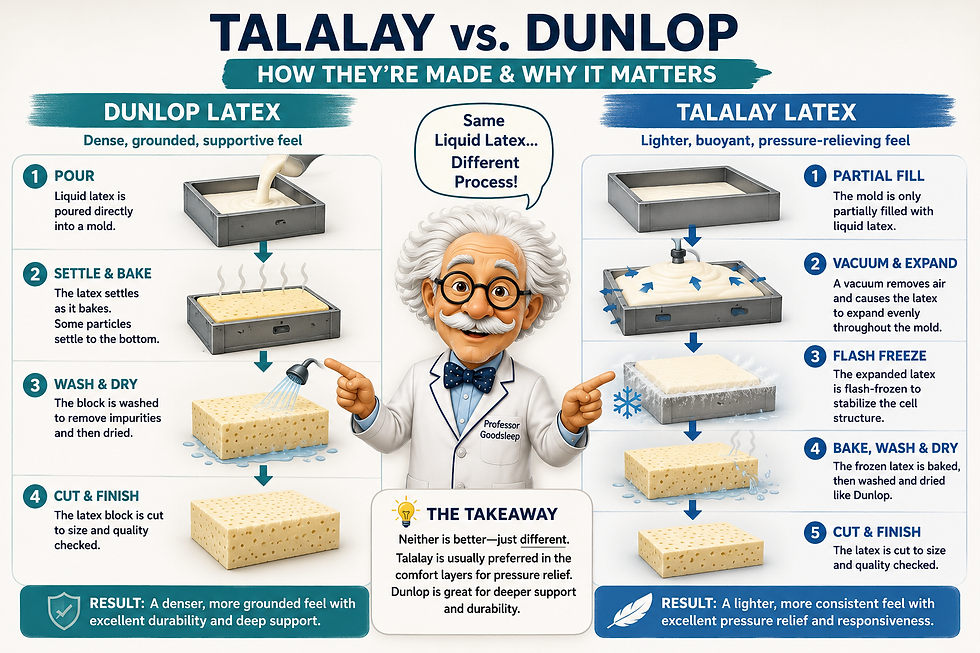
In the Dunlop process, liquid latex is poured into a mold, foamed, and baked. The process is relatively straightforward. Because some of the latex particles can settle during manufacturing, Dunlop often has a denser, more grounded character.
That doesn't mean Dunlop is always hard. It can be made in different firmness levels, including softer versions. However, it generally has a denser and more supportive feel than Talalay.
How Talalay Latex Is Made
Talalay requires additional manufacturing steps. The mold is only partially filled with liquid latex. A vacuum is then used to expand the latex throughout the mold. The material is flash-frozen to help stabilize the cell structure before it is baked and finished.
The result is typically a lighter, more consistent, and more buoyant feel. Talalay tends to compress more easily around pressure points while still responding quickly when you move. This combination is one reason it is often preferred in the comfort layer for dedicated side sleepers.
Talalay vs. Dunlop: The Sales-Floor Difference
From the Sales Floor
The easiest way I can describe the difference is that Dunlop tends to feel denser and more grounded, while Talalay feels lighter, more buoyant, and often more pressure-relieving.
I've compared this directly with mattresses like the Avocado Green Pillow-Top, which has that denser Dunlop character. For a back or stomach sleeper, that can be a great feel. But for many dedicated side sleepers—especially those with broader shoulders—I generally prefer the extra pressure relief and responsiveness of Talalay in the comfort layer.
That doesn't make Talalay universally better than Dunlop. It makes it better suited to certain jobs. Personally, I like Talalay closer to the body for pressure relief and Dunlop deeper in the mattress when additional support is needed.
Is Talalay Better Than Dunlop?
Not universally. I wouldn't call Talalay the better material and Dunlop the inferior one. They are simply better suited to different jobs and different sleepers.
For many side sleepers, I prefer Talalay closer to the body because of its buoyant pressure relief and easier compression around the shoulder and hip. Dunlop can work extremely well deeper in the mattress, where its denser, more grounded feel can provide strong underlying support. Some sleepers also genuinely prefer an all-Dunlop mattress.
Professor Goodsleep's Take: For a dedicated side sleeper, especially one with broad shoulders or prominent hips, it is crucial to pay close attention to the comfort layer. The goal isn't simply to find soft latex; it's to find latex that allows the shoulder and hip to settle in enough to relieve pressure without letting the rest of the body fall out of alignment. For many side sleepers, that's where Talalay has a real advantage.
Why Side Sleepers Are Harder to Fit on Latex
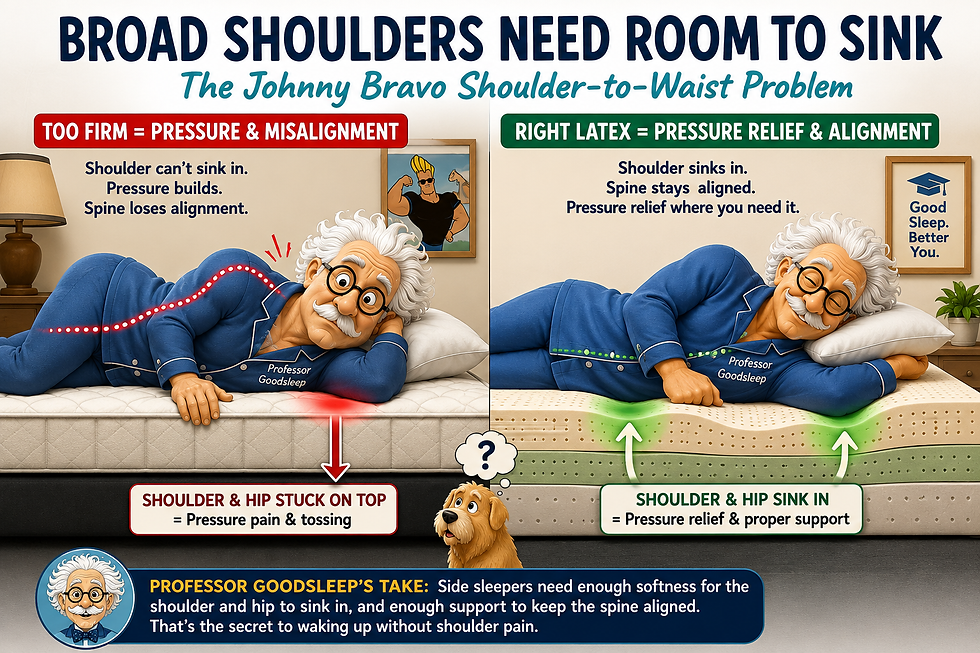
Back sleepers distribute their weight across a large surface area. Side sleepers concentrate much of their body weight onto two pressure points: the shoulder and the hip. If those areas cannot sink into the mattress, pressure builds quickly. Your spine may still be supported, but comfort disappears, and your body keeps waking you up to change positions.
A side sleeper concentrates much of their body weight into two relatively small areas: the shoulder and hip. The mattress must allow those areas to sink deeply enough to relieve pressure while preventing the midsection from dropping too far.
Latex complicates that equation because it is naturally buoyant and resilient. Instead of simply letting your body sink in, it pushes back. This is one of latex's greatest advantages; however, for some side sleepers—particularly lighter individuals or those with broad shoulders—too much pushback can create pressure points.
Professor Goodsleep's Personal Experience
I've experienced this personally. I have broad shoulders and a much narrower waist—what I jokingly call my "Johnny Bravo" build. On a mattress that's too firm, my shoulder takes the punishment. I need enough surface conformity to allow that shoulder to settle into the mattress without losing support through the rest of my body.
The key is not simply whether the latex is soft or firm. What matters is how the mattress responds to the sleeper's body weight, shape, and pressure points while maintaining proper spinal alignment.
The Biggest Mistake I See
Customers often come into the store convinced they need the firmest mattress they can find. After watching thousands of people test mattresses, I've learned that firmness and support are not the same thing. A high-quality mattress can feel plush while still keeping your spine properly aligned.
From the Sales Floor: The Floor Test
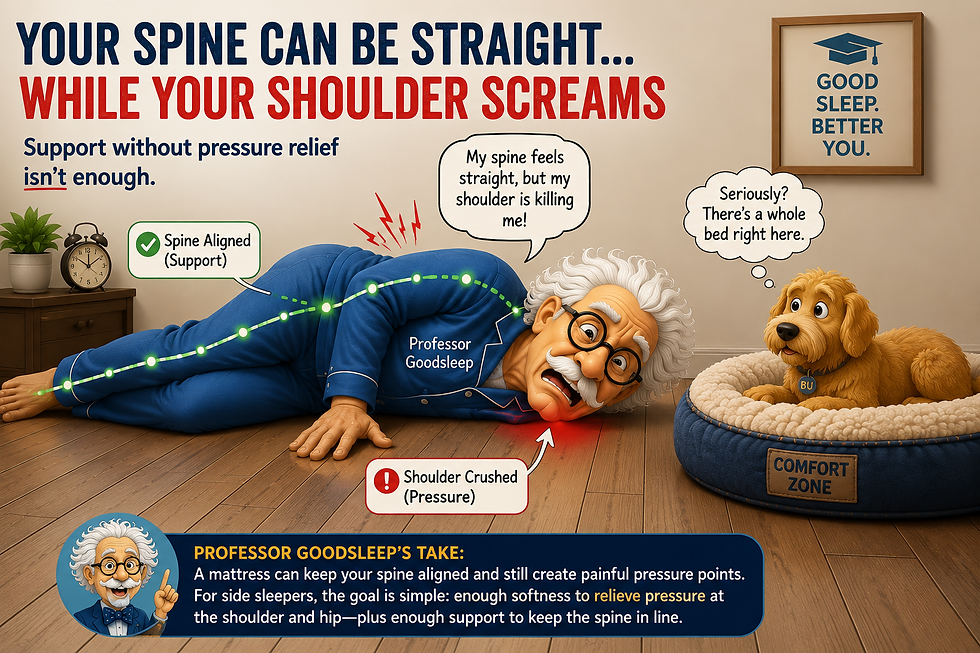
This is one of my favorite demonstrations. I ask customers who are considering a very firm mattress to imagine lying on a hardwood floor for ten minutes. Then I ask one question: 'What starts hurting first?' The answer is almost always the shoulder or the hip. Your shoulder has nowhere to go, so it becomes compressed between your body and the floor. Eventually, your body tells you to move. That is exactly what happens on a mattress that is too firm for a side sleeper.
What Pressure Points Really Feel Like
Pressure points don't always feel like sharp pain. They often show up as shoulder pain, aching hips, tingling fingers, numb arms, waking up with a 'dead arm,' or constantly tossing and turning. Many people blame their pillow when their mattress is actually the source of the problem.
Support and Pressure Relief Are Not the Same Thing
One of the biggest myths in the mattress industry is that firm automatically means supportive. It doesn't. The best side-sleeper mattresses allow your shoulders and hips to sink in just enough while supporting your lower back and keeping your spine aligned.
Professor Goodsleep's Recommendation
If you're a side sleeper, don't judge a mattress by how firm it feels during the first minute. Stay on it for at least 10–15 minutes in your normal sleeping position. Give your shoulders enough time to tell you whether the mattress is relieving pressure or creating it.
Comparison: Firmness vs. Pressure Relief
Extra Firm: Excellent support, poor pressure relief for most side sleepers.
Medium-Firm: Good support, moderate pressure relief.
Medium-Plush: Excellent balance for many side sleepers.
Plush Talalay Latex: Outstanding pressure relief while maintaining support.
Part 2: What Years on the Sales Floor Taught Me
My Own Shoulder Pain Changed How I Recommend Mattresses
I sleep almost exclusively on my side, so I understand shoulder pain personally. After years of trying different mattresses, I discovered I prefer a mattress around a 3 out of 10 on the firmness scale. If my mattress is too firm, I wake up with sore shoulders. For my body, excellent pressure relief matters more than sleeping on the firmest bed in the showroom.
Why I Prefer Talalay Latex
One of the biggest reasons I prefer Talalay latex is how well it relieves pressure around my shoulders. Personally, I don't think I could comfortably sleep on an all-Dunlop latex mattress because it feels too firm for my shoulders. Mattresses like the Avocado Box Top, with its Talalay comfort layer, and the PranaSleep Super Kush provide the type of pressure relief I look for while still keeping my spine properly aligned.
From the Sales Floor: Butch's Story
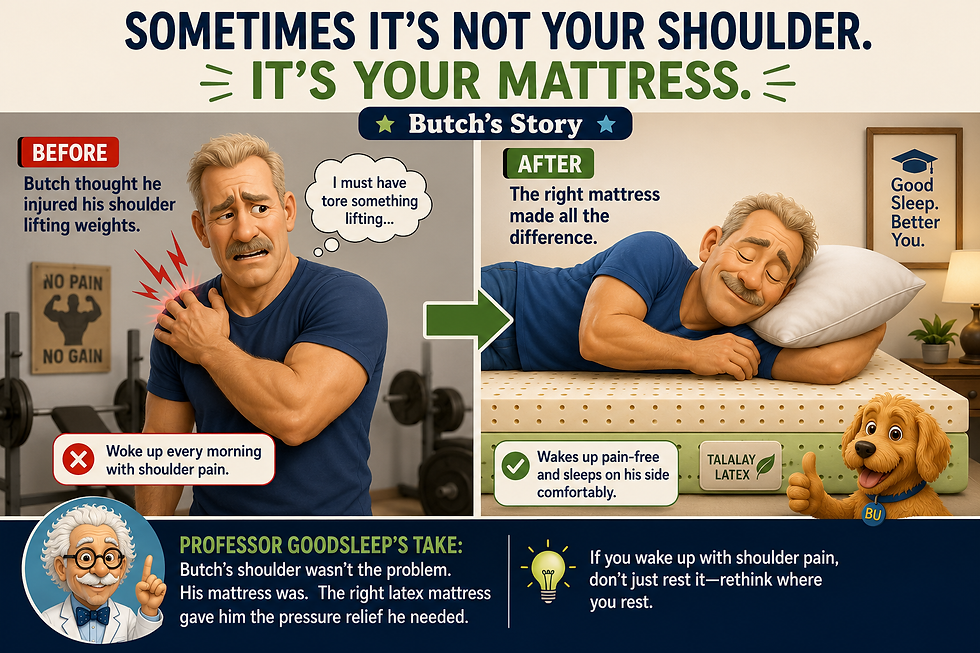
One customer I'll never forget was Butch. He came into the store convinced he had injured his shoulder while lifting weights. The pain had lasted for about six months. Then something unusual happened—it moved to his other shoulder. Since he slept on both sides, he realized it probably wasn't a workout injury after all. I put him on a mattress that was much softer than he expected and asked him to stay on his side for an extended period of time. Even though it felt plush, it was built with premium, high-density materials that still supported his spine. About a month later he emailed me to say his shoulder pain had disappeared and thanked me for helping him find the right mattress.
Why ILD Numbers Don't Tell the Whole Story
Serious latex shoppers often encounter ILD—Indentation Load Deflection—and assume they can simply shop by number. However, an ILD rating by itself does not provide the complete picture.
Two latex layers with similar ILD ratings can feel noticeably different due to several factors, including:
Construction method (Talalay vs. Dunlop)
Layer thickness
Latex density
Layers underneath
Mattress cover and quilting
Sleeper's body weight and shape
The practical takeaway is simple: while specifications are useful, the way a complete mattress interacts with an actual body is more important than any isolated number.
The Latex Layering Sweet Spot for Side Sleepers
For side sleepers, the top few inches of the mattress do much of the pressure-relief work, while the deeper layers provide the support needed to keep the body properly aligned. The ideal construction depends on body weight, body shape, and sleeping habits.
Side-Sleeper Profile
General Latex Setup to Consider
Weight Range | Recommended Setup | Why |
Under 150 lbs | Softer, more conforming comfort layer | Lighter bodies may not compress firmer latex enough for pressure relief |
150–230 lbs | Soft-to-medium Talalay over supportive latex or coils | Balances shoulder and hip relief with alignment |
Over 230 lbs | Thicker comfort system with stronger underlying support | Provides pressure-relief depth without sacrificing support |
Additional Considerations
Broad Shoulders / Narrow Waist: Extra attention to comfort-layer depth and conformity is needed. A larger shoulder-to-waist gap requires more accommodation.
Combination Sleeper: Responsive latex with moderate cushioning makes turning easier than slow-response memory foam.
Important: These are general setups to consider, not rigid prescriptions. Height, body shape, sleep position, mattress construction, and personal preference can all change what feels best.
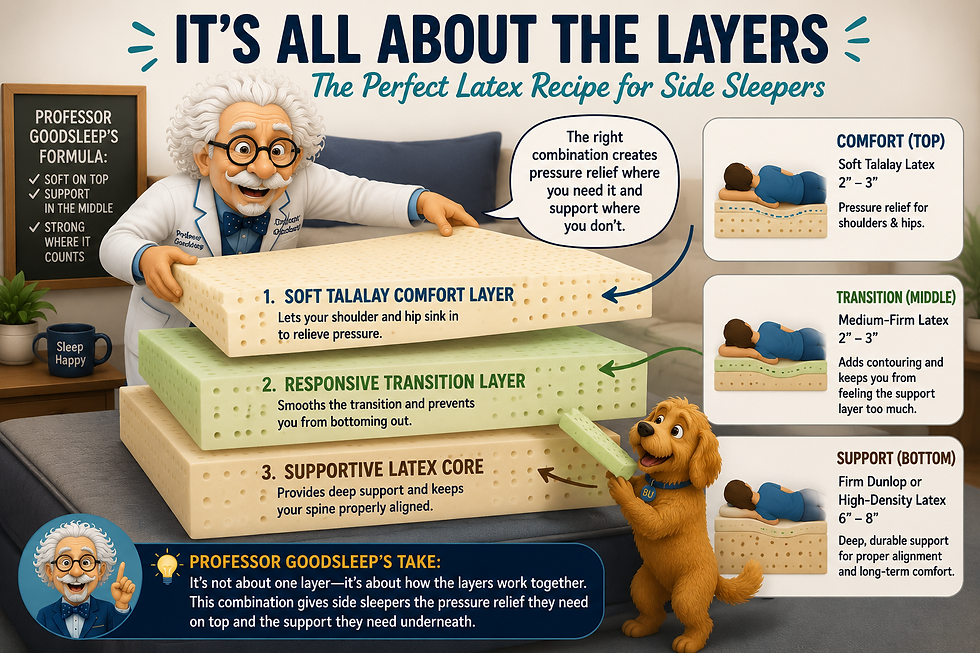
Professor Goodsleep's Recommendation
Your shoulders don't know the brand name—they only know pressure. Your shoulder doesn't care whether the logo says Tempur-Pedic, Helix, Avocado, Beautyrest, or PranaSleep. It doesn't know how much you spent. It only knows whether too much pressure is being placed on it throughout the night. If there is too much pressure, your body responds with shoulder pain, numb arms, tingling hands, tossing and turning, and poor sleep.
One Lesson I Repeat Every Week
Many shoppers tell me a mattress feels too soft after lying on it for less than a minute. I always encourage them to stay there for at least 10 to 15 minutes. Pressure points don't usually appear immediately. Give your body enough time to relax. Your shoulders will often tell you much more than your first impression.
Don't Shop by Brand—Shop by Fit
The same manufacturer can make two mattresses that feel completely different. That's why I encourage people to shop for the mattress that fits their body instead of buying a name. Listen to what your shoulders and hips tell you, not the marketing.
Part 3: Choosing the Right Mattress for Your Body
Not Every Great Mattress Is Great for Every Side Sleeper
One of the biggest mistakes shoppers make is looking for the 'best' mattress instead of the best mattress for their body. Your weight, shoulder width, sleep position, and preference for responsiveness all influence what will feel best.
Professor Goodsleep's Side Sleeper Comparison
Avocado Box Top (Talalay Latex): Excellent pressure relief, responsive feel, outstanding cooling. My favorite natural latex option for many side sleepers.
PranaSleep Super Kush: Exceptional shoulder pressure relief with a luxurious buoyant feel. One of my top recommendations.
Helix Midnight Luxe: Excellent hybrid for side sleepers who want a balance of contouring and support at a lower price than many luxury brands.
Tempur-Pedic LuxeAdapt Soft: Outstanding pressure relief for people who enjoy the slow-response feel of memory foam.
Avocado Pillow Top: A quality mattress with a firmer Dunlop feel. Better suited to sleepers wanting more pushback than the Box Top.
Who Should Choose Talalay Latex?
Talalay is an excellent choice if you sleep on your side, struggle with shoulder or hip pressure, want easier movement than traditional memory foam, or prefer a cooler sleeping surface.
Who Might Prefer Dunlop Latex?
Dunlop is often a better fit for back sleepers, stomach sleepers, or side sleepers who enjoy a firmer, more supportive feel with less contouring.
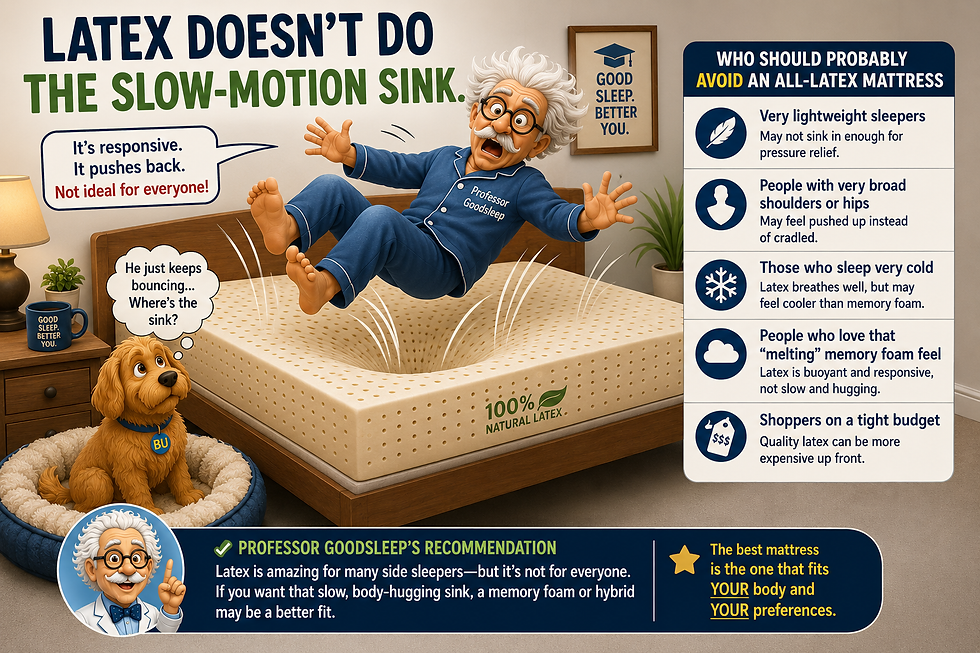
Who Should Probably Avoid an All-Latex Mattress?
Latex is an excellent mattress material, but it is not universally ideal. An all-latex mattress may not be the best choice for someone who:
loves the deep, slow-melting hug of traditional memory foam;
prioritizes maximum motion isolation above everything else;
is highly sensitive to latex's natural buoyancy or pushback;
wants an ultra-light mattress that is easy to move;
has a limited budget and prioritizes the lowest initial purchase price over long-term durability.
There is also an important distinction between disliking an all-latex mattress and disliking latex altogether. A sleeper who does not enjoy the feel of an all-latex design may still love a latex hybrid, because the coil support system can substantially change the overall feel and response of the mattress.
Signs You've Found the Right Mattress
You wake up without shoulder pain, your hips feel comfortable, you aren't constantly rolling over, your spine feels aligned, and you sleep through the night more consistently.
Frequently Asked Questions
Can a mattress that's too firm cause shoulder pain? Yes.
Can it cause numb arms? Yes, excessive shoulder pressure may contribute.
Is softer always better? No. The goal is the softest mattress that still keeps your spine aligned.
Is Talalay better for side sleepers? In my experience, many side sleepers benefit from its superior pressure relief.
Professor Goodsleep's Recommendation
If you're a dedicated side sleeper considering latex, pay particular attention to the top few inches of the mattress. This area is crucial for allowing your shoulder and hip to settle in and relieve pressure.
For many side sleepers, I prefer Talalay latex in the comfort layer due to its lighter, more buoyant pressure relief. Dunlop latex can also provide excellent support, and some sleepers genuinely prefer its denser, more grounded feel.
However, don't choose a latex mattress based solely on the material. Factors such as your body weight, shoulder width, hip shape, and preferred sleeping feel are all important. For example, a 130-pound side sleeper with narrow shoulders should not automatically be shopping for the same mattress as a 250-pound side sleeper with a broad upper body.
The goal isn't to find the softest latex mattress; it's to find one that allows your shoulder and hip to sink in just enough while keeping the rest of your body properly supported.
Final Thoughts
After years helping customers and learning from my own experience, I've found one principle that consistently holds true: The goal isn't to sleep on the firmest mattress. The goal is to sleep on the softest mattress that still keeps your spine properly aligned. If your shoulders and hips are comfortable, your spine stays supported, and you wake up feeling refreshed, you've probably found the right mattress.
If you would like help narrowing the latex and other mattress options for side sleeping, use the free mattress consultation to narrow your shortlist.
Don't Worry, Sleep Happy.
-Professor Goodsleep
Related Articles:



Comments