

Mattress Foam Density Guide: What PCF Is Best for Durability?

Updated: 4 hours ago
Foam density is one of the most important mattress specifications—and one of the least likely to appear on the sales tag. Here is what the number means, what it does not mean, and how to use it without getting fooled.
The short answer
Mattress foam density tells you how much foam material is packed into a given volume. In the United States, it is usually expressed in pounds per cubic foot (PCF). Within the same family of foam, a higher-density formulation will generally resist softening and loss of support better than a lower-density one.
Density is not firmness. A soft foam can be high density, and a firm foam can be low density. Firmness describes how hard a foam feels when compressed; density is a material specification that often tells you more about how well comparable foams may hold up.
Quick PCF guide: For conventional polyfoam, below 1.5 PCF is generally budget-grade, 1.5–1.79 PCF is entry-to-mid-range, 1.8–2.5 PCF is a better-quality range, and 3.0 PCF or higher is premium. These ranges should not be applied directly to memory foam or latex.
Professor Goodsleep's no-BS take: Showroom comfort tells you how a mattress feels today. Foam quality helps determine how much of that comfort will still be there years from now.
What foam density actually measures
Density is mass divided by volume. A foam rated at 1.8 PCF contains 1.8 pounds of material per cubic foot—a cube measuring 12 by 12 by 12 inches. That does not mean a mattress contains one solid cubic-foot block, and it does not tell you the mattress's total weight.
More material in the cell structure generally gives comparable polyurethane foams more ability to retain their original properties. The Polyurethane Foam Association says higher polymer density typically helps foam keep the support and comfort it was designed to provide.
There is an important wrinkle: fillers can increase a foam's scale weight without contributing the same performance as polymer. That is why a serious specification conversation should be about the foam formulation and polymer density—not a vague claim that the finished mattress is “heavy” or “premium.”
Density, firmness, and support are three different things
These terms get mashed together in mattress marketing. They should not.
Specification | What it describes | How it is measured | What it helps predict |
|---|---|---|---|
Density | Mass of foam material in a given volume | Pounds per cubic foot (PCF) | Resistance to softening and property loss within a comparable foam family |
Firmness | Initial resistance or surface feel | Indentation Force Deflection (IFD), often at 25% compression | Whether a foam feels softer or firmer at first contact |
Support factor | How quickly resistance builds with deeper compression | Ratio of 65% IFD to 25% IFD | Ability to avoid bottoming out under greater load |
The practical lesson: Do not let a salesman substitute “firm” for “durable.” Those are different claims.
What Is a Good Foam Density for a Mattress?
This table is a practical shopping guide for conventional flexible polyurethane foam. It is not a universal scale for memory foam, latex, or every proprietary formulation.
Conventional polyfoam density | Practical quality signal | What I would expect |
|---|---|---|
Below 1.5 PCF | Budget-grade | Usually the quickest to soften, especially in thick comfort layers or under heavier use |
1.5–1.79 PCF | Entry-to-mid range | Can be serviceable, but construction, layer thickness, sleeper weight, and price matter |
1.8–2.5 PCF | Better-quality range | Generally a stronger durability choice for most sleepers |
3.0 PCF and above | Premium conventional polyfoam | Greater resistance to softening and body impressions, assuming sound formulation and construction |
There is no honest chart that can turn density alone into an exact number of years. A two-inch layer and a six-inch layer do different jobs. A 120-pound sleeper and a 250-pound sleeper do not stress the surface equally. Heat, moisture, foundations, foam chemistry, quilting, and the rest of the mattress all matter.
Use the ranges as a quality screen— not a lifespan guarantee.
Do not compare density numbers across different foam families
A density number is most useful when comparing like with like.
Compare conventional polyfoam with conventional polyfoam.
Compare memory foam with memory foam of a similar type.
Do not assume latex and memory foam with the same density will feel or perform alike.
Do not assume two proprietary foams are equivalent because one number matches.
Latex, viscoelastic memory foam, high-resilience polyfoam, and conventional polyfoam use different chemistry and cell structures. That is why “higher is always better” becomes bad advice when the comparison crosses material families.
For a deeper look at that trap, read Latex vs. Memory Foam: Why Density Numbers Don't Tell the Whole Story.
Why density matters to Real Comfort Life
A mattress can remain physically intact long after it stops sleeping well. That is the difference between physical life, warranty life, and what I call Comfort Life™.
Type of life | What it means | Why it can end |
|---|---|---|
Physical life | The mattress still exists and can be used | Major structural damage, contamination, or disposal |
Warranty life | A written defect warranty is still in force | Time limit, exclusions, or a claim that does not meet the contract's test |
Comfort Life™ | The mattress still maintains useful comfort, pressure relief, and support | Foam softening, loss of resilience, uneven compression, or weakening support |
I have seen mattresses that were still usable at eight or ten years but had lost much of the comfort that made them worth buying after five or six. That is an observation from real customers—not a promised timeline for every bed.
The question I care about: How close will this mattress feel years from now to the mattress you paid for?
How the Comfort Life™ framework weighs a mattress
My working model puts approximately 80% of Comfort Life™ on comfort/material quality and 20% on support architecture, then adjusts the estimate using real-world evidence.
Comfort Life™ input | Weight | What it includes |
|---|---|---|
Comfort and material quality | 80% | Comfort-foam density and formulation, layer thickness, resilience, quilting materials, and resistance to softening |
Support architecture | 20% | Coil design or support-core quality, transition design, edge construction, and how the layers work together |
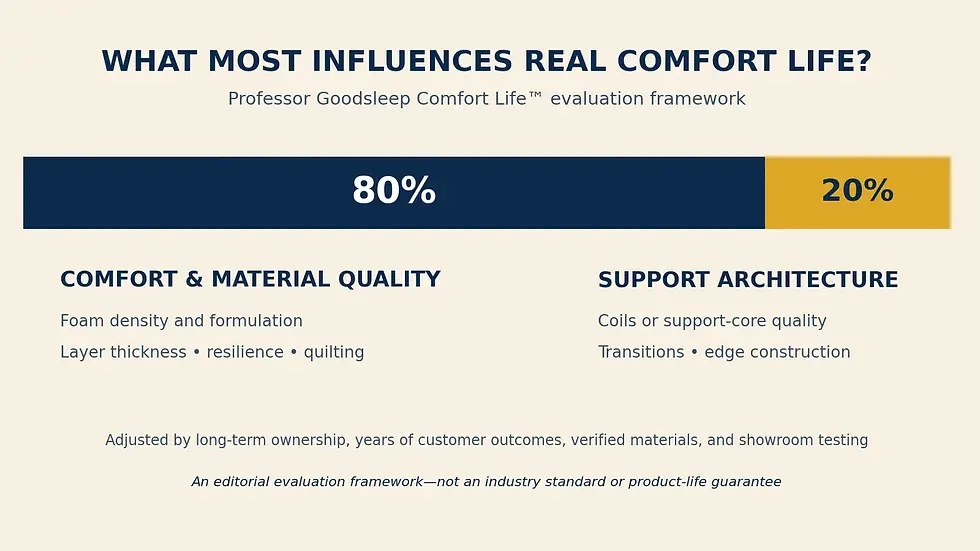
That weighting is a Professor Goodsleep evaluation framework, not an industry standard or laboratory formula. The point is to stop treating a big coil count or a long warranty as if it can rescue weak comfort materials. The sleeper feels the upper layers first, and those layers often determine when the bed stops feeling right.
The low-density failure you can feel before you can see
Lower-density comfort foam can lose resilience without leaving a dramatic crater when nobody is on the bed. Under body weight, however, the weakened area compresses farther than it used to.
Your hips or shoulders sink too deeply, changing alignment.
Your body pushes through the weakened comfort layer and reaches a firmer transition layer, support foam, or coil unit, creating concentrated pressure.
This is why a mattress can feel softer overall yet produce more pressure in the wrong places. Softness by itself is not pressure relief. Good pressure relief requires the comfort layers to distribute weight without collapsing through to the harder structure underneath.

It also explains why some mattresses feel worn out under a sleeper but look almost flat when the person gets up—a problem discussed in our mattress warranty guide.
Where density matters most inside the mattress
Mattress layer | Job | How density affects the decision |
|---|---|---|
Quilting and surface foam | Creates the first feel and early pressure relief | Low-density material can soften quickly; thick amounts deserve more scrutiny than a thin quilting layer |
Main comfort layer | Cradles shoulders and hips and distributes weight | Usually the most important foam-density specification for Comfort Life™ |
Transition layer | Controls the handoff from soft comfort to firm support | Weak material can allow bottoming out or an abrupt, hard feel |
Support foam in an all-foam bed | Carries the mattress's structural load | Density matters greatly because there is no coil unit doing the heavy work |
Foam above coils in a hybrid | Provides comfort while coils carry much of the deep support | A good coil unit cannot prevent weak comfort foam from softening |
Foam edge | Supports sitting and reduces perimeter collapse | Density, thickness, and geometry all matter; a dense label alone does not guarantee a strong edge |
Thickness changes the risk. One inch of lower-density quilting is not the same exposure as four inches of lower-density plush foam. The more low-density material you stack in the main load-bearing comfort zone, the more opportunity there is for the original feel to change.
Why manufacturers often do not publish density
Density is an input cost. In many conventional foams, using more polymer costs more. A manufacturer can sometimes create a similar first impression with a lower-density formulation, a thick quilt package, or a different firmness specification. Both mattresses may feel comfortable for ten minutes in a showroom while carrying very different material value.
That does not mean every company hiding density is selling junk. Proprietary chemistry, supplier agreements, and competitive concerns are real. But when a company makes big durability claims and will not provide any meaningful material specifications, I lower my confidence.
My rule: If the specifications are vague, the durability claim should be treated as vague too.
Density is important—but it is not the whole mattress
Foam density should never be used alone. Also consider:
Foam family and chemistry
Polymer density versus density inflated by fillers
IFD or firmness
Support factor and resilience
Layer thickness and position
Temperature sensitivity
Airflow and moisture exposure
Sleeper weight and whether the same area is loaded every night
Coil design or support-core quality
Foundation and frame support
Quality-control history and real customer outcomes
Independent fatigue testing can also reveal height loss and firmness change after repeated compression. The Polyurethane Foam Association notes that durability tests commonly measure foam height and firmness before and after thousands of compression cycles. A density number is valuable; verified performance evidence is better.
The sales claims that do not replace density
Marketing claim | Why it is not a density specification |
|---|---|
Firm support foam | Firmness and density are independent |
High-density foam | Meaningless without an actual PCF value and foam type |
10-year or lifetime warranty | Warranty length defines contractual coverage, not how long comfort will remain unchanged |
14-inch luxury mattress | Height tells you quantity and architecture, not material quality |
Heavy mattress | Total weight includes coils, fabric, fire barriers, adhesives, and every foam layer |
CertiPUR-US certified | Useful for verified content, emissions, and durability requirements, but it does not disclose each layer's density |
Premium or a proprietary name | Branding is not a measurable specification |
What to ask before you buy
Ask the retailer or manufacturer these questions in writing:
What type of foam is used in every layer?
What is the density in pounds per cubic foot for each polyurethane or memory-foam layer?
How thick is each layer?
Is the reported value polymer density or total foam density with fillers?
What foam forms the support core in an all-foam model?
Are there published fatigue-test results for height loss or firmness change?
If the specifications are proprietary, what measurable durability evidence will the company provide instead?
If the answer is “high density” with no number, ask again. If nobody in the sales chain can answer, make the buying decision knowing that you are taking on more uncertainty.
How I Use Foam Density When Comparing Real Mattresses
When I compare real mattresses, I treat density as one piece of evidence—not a shortcut. A higher-density comfort layer can strengthen my confidence in long-term comfort, but I still weigh layer thickness, sleeper weight, pressure relief, temperature, responsiveness, and the support system.
If a manufacturer does not disclose density, I lower my durability confidence instead of inventing a number. You can see that broader construction approach in my Helix Core vs. Luxe vs. Elite comparison and Tempur-Pedic LuxeAdapt Medium Hybrid vs. Helix Midnight Elite comparison.
Professor Goodsleep's bottom line
Foam density is not a comfort score, and it is not a stand-alone expiration date. It is one of the best clues we have to the material quality hiding under the cover—especially when we compare similar foams doing the same job.
Do not buy a mattress because it is firm, tall, heavy, or backed by a long warranty. Ask what is in the comfort layers. Ask how thick those layers are. Ask for the density in PCF. Then connect those facts to your body weight, sleep position, preferred feel, and budget.
The goal is not to own a mattress that merely survives. The goal is to protect the comfort, pressure relief, and support you bought in the first place.
Frequently asked questions
Is higher-density mattress foam always firmer?
No. Density and firmness are separate specifications. A high-density foam can be engineered to feel soft, and a low-density foam can be engineered to feel firm.
What is a good foam density for a mattress?
It depends on the foam family and the layer's job. For conventional polyfoam, I generally view 1.8–2.5 PCF as a better-quality range and 3.0 PCF or higher as premium. Do not apply those thresholds directly to memory foam or latex.
Does higher-density foam last longer?
Within comparable foam families and constructions, higher polymer density generally improves resistance to softening, height loss, and property change. Formulation, layer thickness, sleeper load, heat, moisture, and the rest of the mattress still matter.
Is memory-foam density measured the same way?
The unit can still be pounds per cubic foot, but memory foam uses different chemistry and commonly falls into different density ranges. Compare it with similar memory foams—not conventional polyfoam or latex.
Does CertiPUR-US certification tell me the foam density?
No. CertiPUR-US certification verifies requirements involving content, emissions, and durability testing. It does not publish the density of every foam layer in a mattress.
Can low-density foam cause back pain?
Foam that has softened unevenly can change spinal alignment or allow the body to bottom out on firmer layers, which may contribute to discomfort. Back pain has many possible causes, so a mattress article cannot diagnose an individual medical problem.
Why does my mattress feel saggy but look flat?
Foam can lose resilience and compress too deeply under body weight, then rebound when the bed is empty. That performance loss may be noticeable to the sleeper before a permanent visible indentation develops.
Get a recommendation based on your body and sleep position
A density number is useful only when it is connected to the complete mattress and the person sleeping on it. Take the Bedding University Professional Mattress Consultation to narrow more than 100 mattresses to the few Professor Goodsleep would actually put you on.
Sources and technical references
Polyurethane Foam Association: Foam Performance — Definitions of density, IFD firmness, support factor, and foam durability testing.
Polyurethane Foam Association: Industry Standards — Overview of ASTM D3574 tests for density, indentation force, fatigue, resilience, and related foam properties.
Polyurethane Foam Association: Glossary — Industry definitions for density, durability, flex fatigue, and flexible polyurethane foam.
CertiPUR-US: What Is Certified Foam? — Scope of certification for foam content, emissions, and durability requirements.
Professor Goodsleep's Comfort Life™ weighting and practical density ranges are editorial evaluation tools based on retail experience, material specifications, construction analysis, and real-world customer outcomes. They are not universal industry standards or product-life guarantees.



Comments