

Can an Adjustable Base Reduce Snoring?

Updated: 4 days ago

If you've read my article about my friend "Needsa CPAP," who has sleep apnea, you may remember his legendary snoring.
This was not a mild snore. He sounded like a busted chainsaw trying to start. When his parents came to visit, his mother could hear him through the walls and often struggled to sleep because of it.
After purchasing an adjustable base from me, he started sleeping in the Zero Gravity position every night. He felt more rested and refreshed, but the real surprise came during his parents' next visit.
His mother didn't hear him snore once.
Now, to be clear, I'm not saying an adjustable base cures sleep apnea. It doesn't. But seeing such a dramatic improvement made me curious about why elevating the upper body can reduce snoring for some people.
Let's take a closer look at how it works.
Why Do We Snore?
Snoring occurs when air has difficulty moving through the throat and airway while you sleep. As the airway narrows, the soft tissues in the throat vibrate, creating the familiar snoring sound.
Several factors can contribute to snoring:
Sleeping flat on your back
Excess weight around the neck
Nasal congestion
Relaxed throat muscles during sleep
Obstructive sleep apnea
When you lie completely flat, gravity can allow your tongue and soft tissues to fall backward toward your airway, making it more difficult for air to flow freely.
How an Adjustable Base Can Help
An adjustable base elevates your head and upper body slightly. This position helps gravity work in your favor instead of against you.
When your upper body is raised:
The airway tends to remain more open
The tongue is less likely to fall backward
Throat tissues experience less collapse
Air can move more freely through the airway
For many people, this can significantly reduce snoring.
How High Should Your Head Be Raised?
Most people who notice improvement are only raising the head of the bed a few inches. It is usually much less than people imagine.
A slight incline is often all that's needed to help keep the airway more open while remaining comfortable enough to sleep naturally.
The goal isn't to sleep sitting up. The goal is simply to allow gravity to help keep the airway from narrowing during sleep.
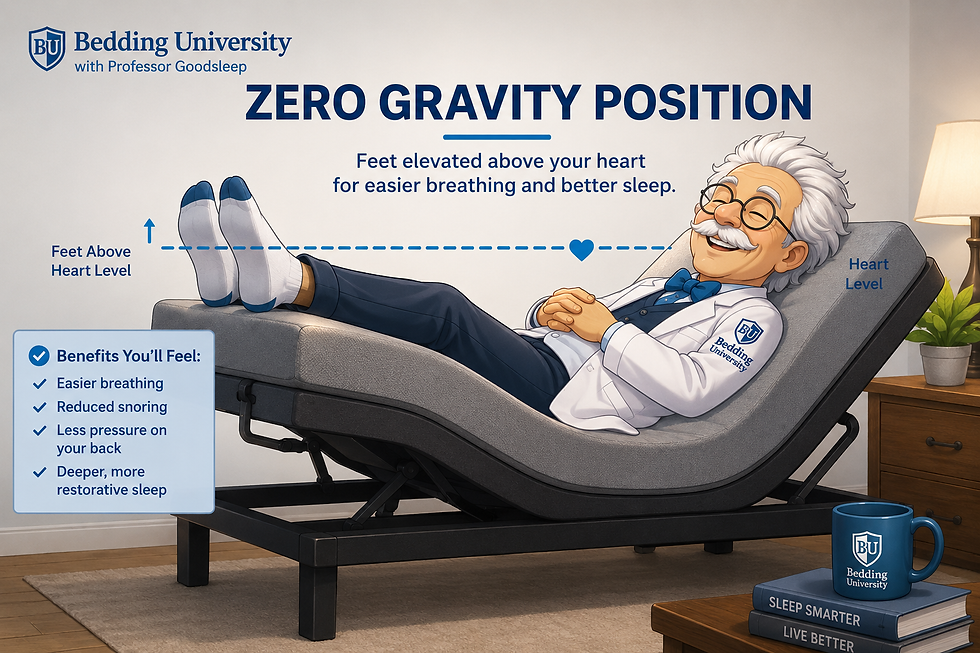
What Is the Zero Gravity Position?
The Zero Gravity position was inspired by the posture astronauts assume during launch.
In this position:
The head is elevated
The knees are slightly elevated
Pressure on the lower back is reduced
Body weight is distributed more evenly
Many people report:
Less snoring
Reduced pressure points
Better circulation
Less tossing and turning
Can an Adjustable Base Cure Sleep Apnea?
No.
An adjustable base is not a cure for obstructive sleep apnea, and anyone who suspects they have sleep apnea should speak with their doctor.
However, some people with mild sleep apnea or positional sleep apnea may notice fewer symptoms when sleeping with their upper body elevated.
For diagnosed sleep apnea patients, an adjustable base is often used alongside medical treatments such as CPAP therapy.
Final Thoughts
I told the full story of my friend "Needsa CPAP" in another article, but his experience is one of the most dramatic examples I've personally seen of how sleeping position can affect snoring.
An adjustable base won't solve every sleep problem, but for some people, making a small adjustment to their sleeping position can make a surprisingly big difference.
If your snoring sounds anything like my friend's used to, it may be worth exploring whether elevation helps you breathe and sleep more comfortably.
If you are separately choosing a mattress for your adjustable-bed setup, get 3–5 mattress recommendations instantly with the free consultation. No email is required.
Don't Worry, Sleep Happy.
Professor Goodsleep
Related Articles:



Comments