

Helix vs. Purple: Which Mattress Is Better? A Mattress Expert's Real-World Comparison

Updated: 4 days ago
By Professor Goodsleep | Bedding University


If you're comparing Purple and Helix, you're looking at two mattress brands that approach comfort in fundamentally different ways.
I've personally sold and tested both brands on the sales floor, and the biggest difference isn't a specification you'll find buried in a product chart. It's how these mattresses actually feel when you lie down on them.
Purple uses its distinctive GelFlex Grid, creating a bouncy, buoyant sensation unlike a conventional mattress. Helix uses a more traditional hybrid construction, combining multiple foam layers with individually wrapped coils to create pressure relief without quite as much of the deep, stuck-in-the-bed feeling associated with some dense memory-foam mattresses.
Purple is the more unique and polarizing mattress, while Helix is the more familiar and predictable choice. Neither is automatically better, but depending on how you like a mattress to feel, there's a good chance you'll strongly prefer one over the other.
Still not sure which mattress fits you?
Your sleep position, body weight, pressure points and budget can change the answer. Answer a few questions and I’ll narrow more than 100 mattresses to the few I’d actually put you on.
Free • About 2 minutes
The Biggest Difference: Purple's GelFlex Grid vs. Helix's Layered Hybrid Feel
Purple doesn't feel like a conventional memory-foam mattress. Its defining feature is the GelFlex Grid—a flexible grid structure that compresses under pressure while remaining supportive in other areas.
The first thing I notice when lying on a Purple is just how bouncy and buoyant that grid feels. The closest comparison I can make is almost like a waveless waterbed. I don't mean that you're sloshing around or sinking uncontrollably; it's more of a buoyant, floating sensation where the surface reacts quickly beneath your body.
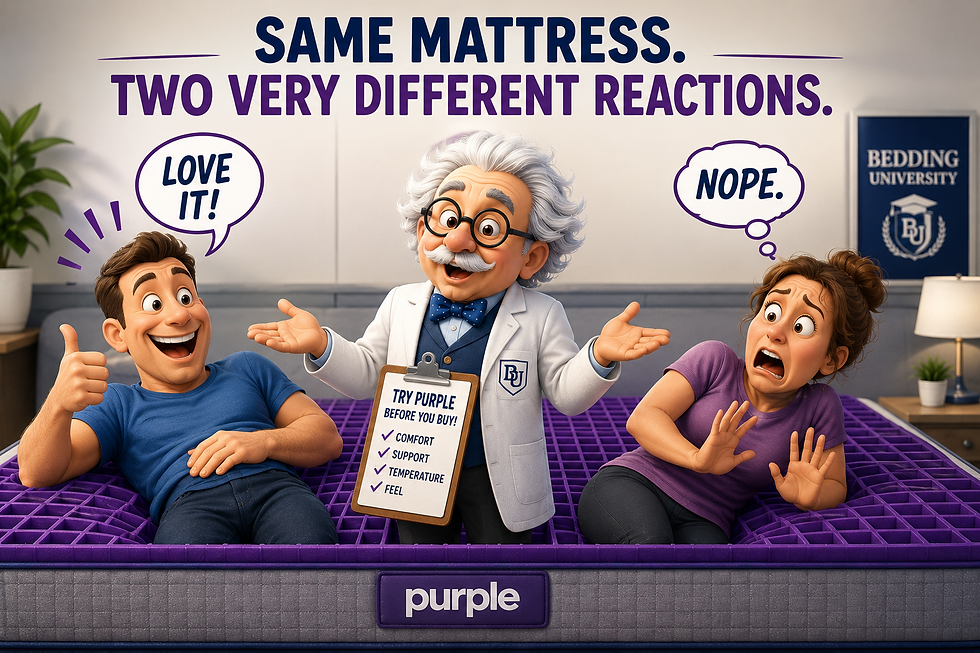
However, there's something else I notice that doesn't always come across in online mattress descriptions: I can actually feel that I'm lying on a grid. Particularly where the vertical and horizontal sections of the GelFlex Grid intersect, I can sometimes feel those individual points beneath me. Some people won't mind this at all; some may even love it. Others will lie down and know almost immediately: This mattress isn't for me.

Professor Goodsleep's Recommendation: Try Purple Before You Buy
Purple is one of the mattresses I most strongly recommend trying in person before purchasing. I've watched a fair number of customers lie down on a Purple mattress and decide very quickly that they don't like the feel. That doesn't make Purple a bad mattress; it makes Purple a polarizing mattress.
Some sleepers love the buoyancy, responsiveness, and unusual pressure relief of the GelFlex Grid, while others immediately notice the bounce or the physical sensation of the grid beneath them and want something more traditional.
If you're seriously considering Purple, my recommendation is simple: Spend at least 10 to 15 minutes lying on one in your normal sleeping position before buying, if you have the opportunity. This isn't a mattress I'd choose based on specifications alone.
How Helix Feels Different
Helix is much closer to what most people expect a premium hybrid mattress to feel like. One of the things I've noticed about Helix is how its foam layers work together. There's a slightly less-dense, more responsive foam near the top, with the denser memory foam positioned farther down in the comfort system.
I think that's a big part of why Helix doesn't give you as much of that classic stuck-in-the-bed feeling that some dense memory-foam mattresses can create. You still get the pressure relief of dense memory foam, but because that denser foam is farther down in the comfort system rather than being the immediate surface you're sinking into, you don't feel quite as trapped by it.
The more responsive upper foam gives the mattress a little more freedom of movement, while the denser memory foam underneath can still contour around the body and help relieve pressure. In simple terms: You still get the benefits of dense memory foam—it's just one layer down, so you don't feel quite as swallowed by it.
Compared with Purple, Helix is still the more traditional-feeling mattress. Purple's GelFlex Grid is considerably bouncier and more buoyant, while Helix feels more conforming, grounded, and familiar.

Purple vs. Helix for Cooling
The GelFlex Grid contains large, open channels that naturally allow air to move through the mattress. Air has room to circulate, and body heat has somewhere to disperse rather than becoming trapped in a thick slab of dense foam.
From my experience on the sales floor, we don't get many complaints from Purple owners about sleeping hot. I wouldn't necessarily describe Purple as actively cooling; to me, it's more accurate to call it temperature neutral.
Some mattresses use cool-to-the-touch covers or other materials designed to initially feel cold against your body. Purple's advantage is more fundamental to its construction: The open grid naturally gives heat somewhere to go.
Helix also performs well in this area based on my sales-floor experience. I haven't encountered many complaints about Helix mattresses sleeping excessively hot either. My sales-floor experience shows that both perform well for temperature regulation, with Purple having the more naturally open and breathable comfort-layer design.
Don't Assume Purple's 'Soft' Means Truly Soft
A manufacturer's firmness label doesn't always match how a mattress actually feels to you. Most of the newer Purple mattresses I've tested with a 3-inch GelFlex Grid may be described as soft, but that's not how I would personally rate them. To me, they're closer to a medium feel.
The GelFlex Grid is responsive and pressure relieving, but responsive isn't necessarily the same as soft. The grid pushes back against your body, creating more of a buoyant, floating sensation than the deep, enveloping sink you'd get from a truly soft foam mattress.
If you're specifically looking for an ultra-plush mattress, don't assume that a Purple labeled soft will necessarily feel as soft as you expect.
A Real-World Experience With the Older Purple 4
I have a friend who owns an older Purple mattress that I believe was the Purple 4, one of the company's softer previous-generation models. When it was new, it was very soft—which was exactly what he wanted because he prefers a soft mattress.
Over time, however, he told me that the mattress seemed to collapse or compress down more and eventually developed a noticeably firmer feel. Since he's someone who specifically prefers a softer mattress, he wasn't particularly happy with how the feel changed.
This is one person's experience with an older Purple model. I'm not claiming every Purple 4 had this issue or that every current Purple mattress will experience the same thing. The older Purple 4 used an unusually deep and soft grid construction. In my opinion, making the grid that soft also made it more collapsible under the body.
Purple's newer lineup has largely moved away from that exact ultra-soft approach. Many of the newer Purple mattresses I've tested use a 3-inch GelFlex Grid, which, to me, produces a feel closer to medium—even when the mattress itself may be described as soft.
Which Mattress Is Easier to Move Around On?
Purple wins this category. The GelFlex Grid is extremely responsive. When you move, the material responds almost immediately rather than slowly holding the impression of your body.
Helix also performs better in this area than some dense memory-foam mattresses. Because Helix uses a slightly less-dense and more responsive foam near the surface, with denser memory foam farther down in the comfort system, you're not immediately sinking directly into the slowest-responding foam.
Purple is considerably bouncier and more responsive. Helix is more conforming and body-hugging without feeling as restrictive as some dense memory-foam mattresses.
Which Is Better for Pressure Relief?
Purple and Helix relieve pressure in completely different ways. Purple's grid is designed to buckle under concentrated pressure while remaining supportive elsewhere. Helix takes a layered approach: the more responsive foam closer to the surface allows easier movement, while the denser memory foam underneath can still contour around the body and provide pressure relief.
For someone who loves traditional memory-foam pressure relief but doesn't want to feel excessively stuck, I'd lean toward Helix. For someone who dislikes sinking into foam and prefers a buoyant surface that responds immediately, Purple may be the better choice.
The real question is: How do you want that pressure relief to feel?
Purple vs. Helix for Side Sleepers
For side sleepers, pressure relief around the shoulders and hips is critical. I'd be cautious about declaring either brand the universal winner because body weight, shoulder width, hip shape, and personal preference all affect how a mattress feels.
Helix is probably the more predictable choice for a side sleeper who wants traditional contouring around the shoulders and hips. Purple can also provide excellent pressure relief for the right person, but the sensation is much more distinctive. Because I personally find many of the 3-inch-grid Purple models closer to medium than truly soft, I wouldn't automatically assume that a Purple labeled soft will provide the deeply plush experience some side sleepers are looking for. Try it first if you can.
Purple vs. Helix for Combination Sleepers
If you frequently change positions during the night, Purple has a natural advantage in responsiveness. The GelFlex Grid reacts immediately when you move. There's virtually none of the slow recovery you can experience with traditional dense memory foam.
Helix, however, shouldn't be dismissed here. The more responsive upper foam layer helps make position changes easier, while the denser memory foam underneath still contributes contouring and pressure relief.
Purple is the better choice if maximum responsiveness and easy movement are your priorities. Helix is the better compromise if you want memory-foam pressure relief without an excessive stuck-in-the-bed feeling.
Purple vs. Helix for Couples
For couples, I would focus heavily on individual preferences. If both people love Purple's GelFlex Grid, it can be an excellent choice. However, because the Purple feel is so distinctive and polarizing, there's also a greater chance that one partner loves it while the other doesn't. I've seen enough people lie down on Purple and quickly decide that the unusual grid sensation isn't for them that I would consider this a legitimate concern for couples.
Helix's more conventional hybrid feel may be easier for a broader range of sleepers to agree on. This doesn't automatically make Helix the better couples mattress, but when two people with different preferences are trying to compromise, a more familiar mattress feel can sometimes make that compromise easier.
Who Should Choose Purple?
Purple makes the most sense if you love a bouncy, buoyant, and highly responsive mattress; dislike the slow sink of traditional memory foam; want strong natural airflow through the comfort layer; change positions frequently; or have tried the GelFlex Grid and genuinely enjoy its unique sensation.
I'd be more cautious about Purple if you're highly sensitive to unusual textures or sensations beneath your body, dislike bounce, or want a truly plush, deeply cushioning feel.
Who Should Choose Helix?
Helix makes the most sense if you prefer a more traditional premium hybrid feel; want the pressure relief of dense memory foam; like some contouring but don't want an excessive stuck-in-the-bed sensation; or prefer a more familiar and predictable mattress experience.
For many shoppers buying without first testing the mattress, I consider Helix the safer choice simply because its feel is less polarizing.
Professor Goodsleep's Final Verdict: Purple or Helix?
If you're asking me which mattress is objectively better, I don't think that's the right question. These mattresses feel too different for a simple universal winner. Purple is the more unique mattress, while Helix is the more familiar mattress.
Purple's GelFlex Grid is bouncy, buoyant, and highly responsive. It provides excellent natural airflow and creates a sleeping sensation you simply won't get from a traditional memory-foam hybrid. However, that uniqueness is also its biggest risk. I've watched enough customers lie down on Purple mattresses and quickly decide they're not for them that I strongly recommend trying one before buying whenever possible.
Helix takes a more layered approach to memory-foam comfort. A slightly less-dense, more responsive foam sits closer to the surface, while denser memory foam is positioned farther down in the comfort system. In my experience, that's a major reason Helix can provide the pressure relief associated with dense memory foam without creating quite as much of the deep, stuck-in-the-bed sensation some memory-foam mattresses are known for.
You still get the pressure relief; it's just one layer down, so you don't feel quite as swallowed by it.
If you love bounce, buoyancy, immediate responsiveness, and the unique feel of the GelFlex Grid, choose Purple. If you prefer a more traditional hybrid feel with dense memory-foam pressure relief but less of a stuck-in-the-bed sensation, choose Helix. And if you've never tried a Purple, try one before buying if at all possible. With Purple, your body may make the decision within the first few minutes.
If you are still deciding how Purple and Helix fit your preferences, start the free mattress consultation for 3–5 instant mattress recommendations. No email required.
Don't Worry, Sleep Happy.
Professor Goodsleep
Related Articles:


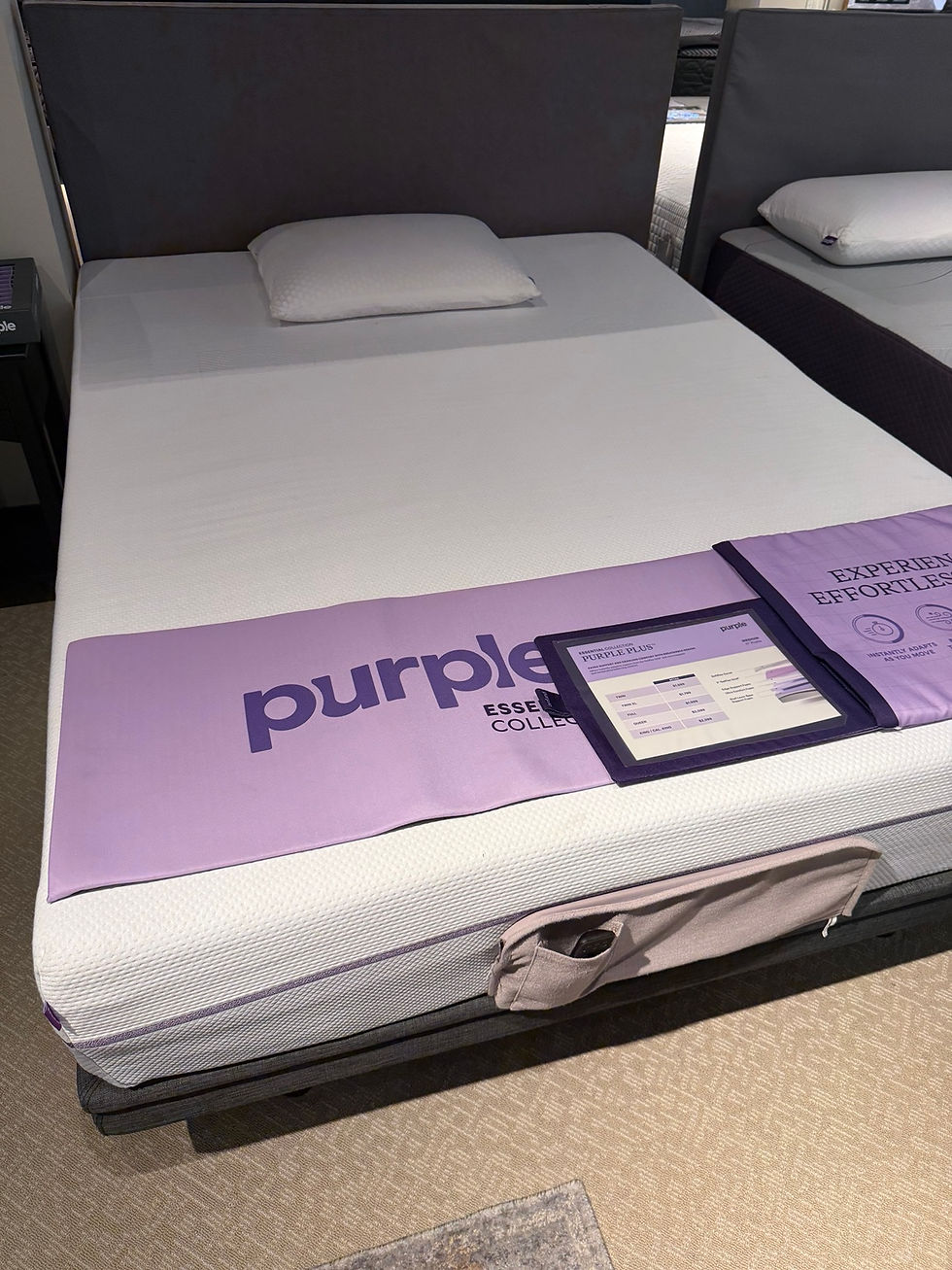
Additional showroom photos — September 2026
These firsthand photographs were taken by Professor Goodsleep during in-store mattress testing. Any prices or promotions visible on model cards were photographed in September 2026 and may change.




Can You Try Helix in a Store?
Yes, in some areas. Helix began as an online mattress brand, but its showroom and retail availability is expanding through selected mattress and furniture stores. Availability remains regional, so many shoppers will not have a nearby location. Check Helix’s current store locator before making a special trip; if no store is close, the home trial remains the practical way to test one.



Comments