

Nectar vs Tempur-Pedic: A Lesson in Value—What Are You Paying More For?

Updated: 4 days ago

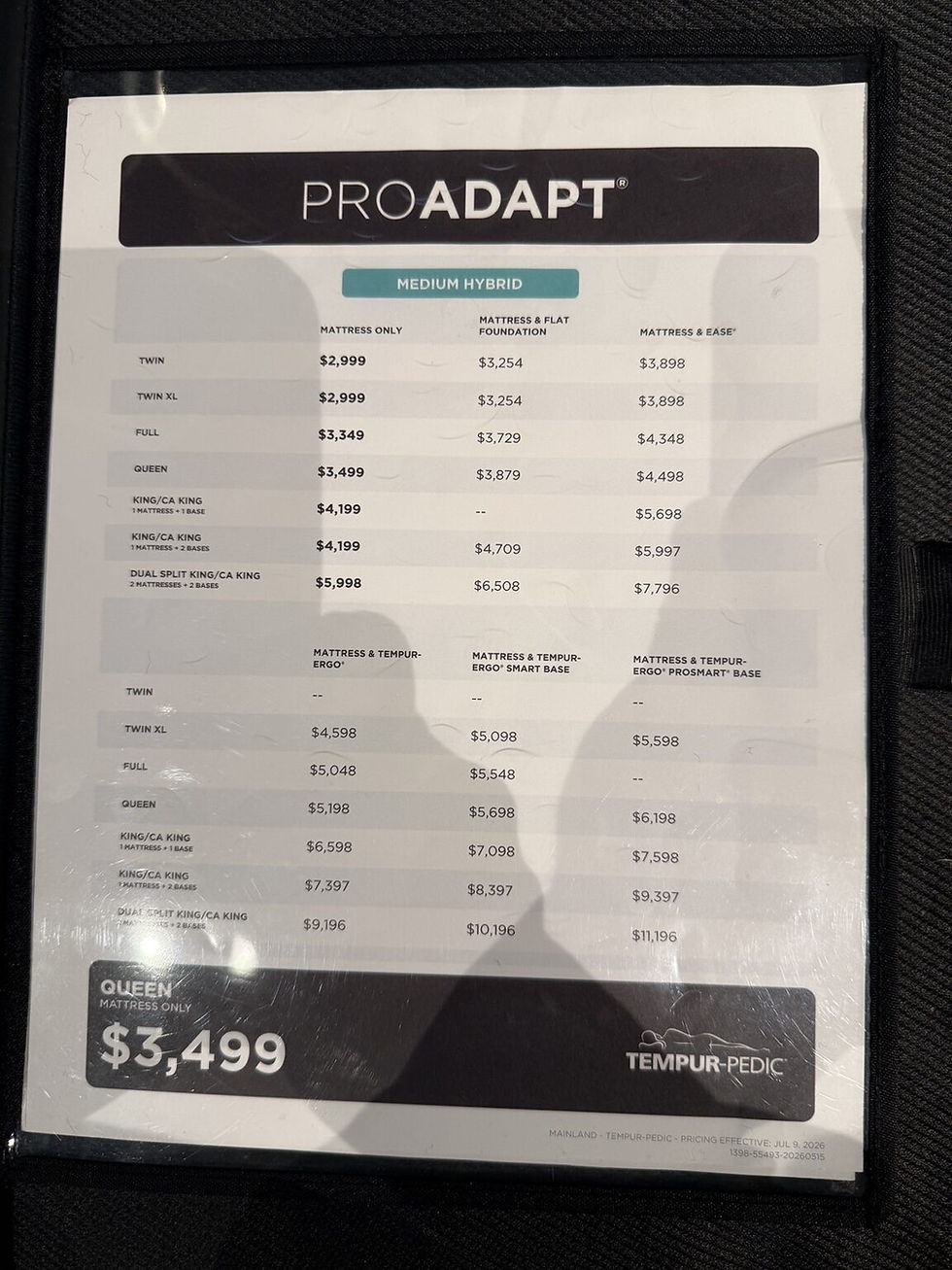
If you're comparing Nectar and Tempur-Pedic, you're probably asking one very simple question:
Is Tempur-Pedic really worth spending thousands of dollars more?
I've sold both Nectar and Tempur-Pedic, along with brands like Beautyrest, Stearns & Foster, Purple, Helix, Sealy, Serta, Aireloom, King Koil, PranaSleep, and Casper.
And here's the short answer:
Tempur-Pedic is clearly the better mattress. Nectar is the lower-price compromise.
That is not a close call for me. Tempur-Pedic has the proven track record, dense proprietary foams, deep pressure relief, excellent motion isolation, and known durability. Nectar feels like many lower-density bed-in-a-box foam mattresses: you sink through the memory foam quickly, which raises serious questions about how well it will maintain comfort and support over time.


The real question is whether your budget allows you to buy the better mattress. For an adult's primary bed, I recommend Tempur-Pedic when the price is manageable. Nectar makes the most sense for a strict budget, a child's mattress, or a guest bedroom.

Quick Verdict
Choose Tempur-Pedic if: You are buying a primary mattress and want the better combination of pressure relief, motion isolation, material quality, and proven durability.
Choose Nectar if: You are on a strict budget or furnishing a child's room, guest room, or other lower-use sleeping space.
Professor Goodsleep's quick take: Tempur-Pedic is the clear winner and the mattress I recommend here. I would not generally recommend Nectar for an adult's primary mattress unless budget leaves very few alternatives.
Deciding between Nectar and Tempur-Pedic? Build a shortlist with the free mattress consultation: 3–5 mattress recommendations instantly, with no email required.
Nectar vs. Tempur-Pedic Comparison
Category | Nectar | Tempur-Pedic |
Price | Much lower | Premium |
Feel | Memory foam, varies by model | Deep, slow-response memory foam |
Pressure Relief | Good | Excellent |
Motion Isolation | Very good | Excellent |
Varies by model | Better in Breeze models | |
Foam Quality | Lower-density bed-in-a-box feel | Premium high-density foam |
Ease of Movement | Depends on model | Can feel difficult to turn on |
Durability | Serious long-term concerns | Proven durability advantage |
Best For | Strict budgets, kids, guest rooms | Premium memory-foam shoppers |
The Biggest Difference: Price and Foam Quality
The biggest difference between Nectar and Tempur-Pedic is straightforward: Tempur-Pedic uses denser, more premium memory foam with a long performance track record. Nectar costs considerably less, but it also feels like the lower-cost construction.
I've sold mattresses for more than a decade, and one thing I always try to explain to customers is that you can't judge memory foam by simply pressing your hand into it for five seconds. Foam density matters.
Higher-density memory foam generally costs more to manufacture and tends to provide better durability and a more substantial, pressure-relieving feel. Tempur-Pedic has long been known for using very dense proprietary foams, with some TEMPUR materials historically falling into approximately the 4- to 6-pound density range or higher, depending on the specific foam and model.
That is why Tempur-Pedic feels so different from most inexpensive memory-foam beds. Nectar's foam compresses and lets you sink through more quickly. TEMPUR material starts denser and somewhat firmer, then slowly softens and molds around the body as it responds to heat and weight.
Comfort and Feel: These Mattresses Don't Feel the Same
Tempur-Pedic has one of the most distinctive feels in the mattress industry. You lie down, and the foam slowly begins to conform around your body. It doesn't immediately spring back; instead, it absorbs your weight and gradually molds to your shape.
Some people absolutely love it. Others don't. One disadvantage of traditional slow-response memory foam is that it can be more difficult to turn over and change positions. The mattress isn't helping push you back up; you're moving out of an impression that has formed around your body.
I've explained this to customers for years by comparing memory foam with latex. Memory foam lets you sink in; latex pushes back. Neither is automatically better. They're simply very different sleeping experiences.
Nectar also uses memory foam, but depending on the specific model, it generally doesn't have quite the same deep, slow-moving, dense feel that has made Tempur-Pedic famous. If you want the classic sensation of being deeply cradled by memory foam, Tempur-Pedic has the advantage. If you prefer a somewhat easier-moving feel—or simply don't want to spend several thousand dollars—Nectar may make more sense.
Pressure Relief: Advantage Tempur-Pedic
This is one area where I give Tempur-Pedic a clear advantage. High-quality memory foam can be exceptional at distributing body weight and reducing pressure around areas like the shoulders and hips, which is especially important for side sleepers.
When you sleep on your side, much of your weight is concentrated around relatively small areas of the body. A mattress that's too firm can create pressure points at the shoulder and hip, potentially leading to tossing, turning, numbness, or discomfort. Tempur-Pedic's dense, conforming foams are particularly good at relieving that pressure.
Nectar can also provide good pressure relief, particularly in its softer and more substantial models, but if maximum pressure relief is your top priority, I would generally give Tempur-Pedic the edge.
Cooling: Don't Assume Memory Foam Sleeps Cool
This is where shoppers need to be careful with marketing. Memory foam has historically had a reputation for retaining heat because your body sinks into the material, increasing the amount of surface area touching the mattress.
Manufacturers have responded with cooling covers, gel infusions, phase-change materials, ventilation systems, and other technologies. Some work better than others. Tempur-Pedic's Breeze collection is specifically designed for cooling, and in my personal experience, the TEMPUR-LuxeBreeze is the best cooling memory-foam mattress I've personally tested.
I've spent more than 30 minutes lying on one in a showroom, and the cooling effect was genuinely noticeable. But there's a trade-off. The LuxeBreeze is expensive, and I've found its feel somewhat firmer and less conforming than mattresses in the Adapt collection.
Nectar also offers cooling features that vary by model, but I wouldn't automatically choose either brand solely because of a cooling claim. If you're a genuinely hot sleeper, look beyond the words cooling, gel, or temperature regulating and consider the entire mattress construction.
Motion Isolation: Both Are Strong
If you sleep with a partner, motion isolation can make a major difference. Traditional memory foam is excellent at absorbing movement, and this is an area where both Nectar and Tempur-Pedic perform well.
If your partner rolls over, gets out of bed, or changes positions during the night, less of that movement should transfer across the mattress compared with a highly responsive traditional innerspring. Tempur-Pedic gets the edge here because of its dense, motion-absorbing foam, but Nectar is also a strong option for couples who want to minimize partner disturbance.
Durability: Tempur-Pedic Has the Advantage
No mattress lasts forever, but foam quality and density matter enormously in how well a bed maintains comfort and support. Nectar gives me the same low-density, quick-sink feel I find in many inexpensive bed-in-a-box mattresses. Based on that feel and construction, I have serious questions about its useful life as an adult's everyday mattress.
Tempur-Pedic has the clearer track record. Its dense foams are designed to adapt slowly and support the body instead of letting the sleeper sink through the comfort layer immediately. Individual results still depend on body weight, use, foundation support, and model, but Tempur-Pedic is the much safer durability choice.
For a primary mattress, that durability advantage helps justify the higher initial price. A low purchase price is not automatically a better value if the comfort layers lose their support sooner.
When Nectar Still Makes Sense
Nectar's strongest argument is price. If the choice is between staying within a firm budget and not replacing the mattress at all, its lower cost can make it a practical option.
It can also make sense for a child's room, a guest bedroom, a temporary living situation, or another bed that will not receive the same nightly use as an adult's primary mattress.
But I would not confuse lower price with better overall value. For most adults buying the mattress they plan to sleep on every night, Tempur-Pedic's pressure relief, denser materials, and durability record make it the better investment if they can afford it.
With Nectar, you are accepting a meaningful material and longevity trade-off to reduce the upfront cost. That may be reasonable in the limited situations above, but it is not the recommendation I would make for most primary-bedroom shoppers.

Professor Goodsleep's Recommendation
I've sold both Nectar and Tempur-Pedic, and my recommendation is clear: Tempur-Pedic is the better mattress. Nectar belongs in a much narrower budget category.
If you are buying an adult's primary mattress and can comfortably afford it, I would choose Tempur-Pedic. Its pressure relief, motion isolation, dense slow-response feel, material quality, and known durability provide legitimate reasons for the higher price.
I would consider Nectar mainly for someone on a strict budget, for a child's mattress, or for a guest bedroom. Its memory foam feels soft and inviting at first, but I sink through it quickly, and that leaves me with serious questions about long-term comfort and support.
Here is the bottom line:
Tempur-Pedic is the better mattress and my recommendation. Nectar is simply the less expensive option.
If the price of Tempur-Pedic is out of reach, Nectar can fill a limited budget need. But when both are realistic choices for a primary bed, I would buy Tempur-Pedic.
Who Should Choose Nectar?
You are working within a strict mattress budget.
You are furnishing a child's bedroom or guest room.
The mattress will receive occasional or short-term use.
Lower upfront cost matters more than premium materials or long-term durability.
You understand and accept the trade-off in foam quality and expected useful life.
Who Should Choose Tempur-Pedic?
You love the distinctive, slow-response TEMPUR feel.
Deep pressure relief is a top priority.
You're a side sleeper who needs excellent cushioning around the shoulders and hips.
Motion isolation is extremely important.
You're willing to pay more for dense premium foam and Tempur-Pedic's proven durability record.
Budget isn't your primary concern.
Final Verdict: Nectar vs. Tempur-Pedic
Tempur-Pedic wins this comparison clearly. It is the better mattress for material quality, pressure relief, motion isolation, support, and expected durability. Nectar wins only on initial price.
That does not mean every shopper must stretch beyond a responsible budget. Nectar can serve a purpose in a child's room, guest room, temporary setup, or strict-budget purchase. But those limited uses are different from saying it is the better value for an adult who will sleep on it every night.
For a primary mattress, the important question is whether you can comfortably afford Tempur-Pedic—not which mattress is better. Tempur-Pedic is better.
If you like the dense, slow-response TEMPUR feel and the price is manageable, Tempur-Pedic is my choice without hesitation. I would choose Nectar only when budget or limited-use circumstances make the lower upfront cost the deciding factor.
Don't Worry, Sleep Happy.
Professor Goodsleep
Not sure which mattress truly fits your body, sleep position, comfort preferences, and budget? Start with the Professional Mattress Consultation first.
If you already know which brand fits you, check current pricing below. Affiliate disclosure: Bedding University may earn a commission from qualifying purchases at no extra cost to you.

Related Articles:
Best Mattress for Hot Sleepers



Comments