

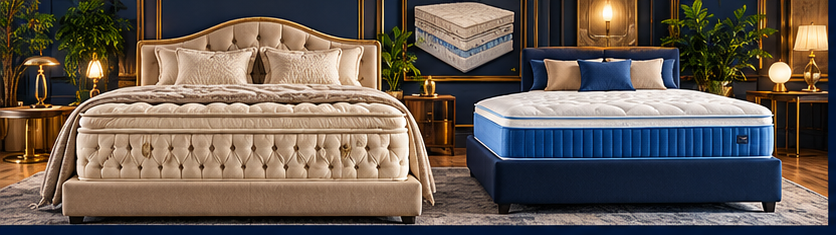
Aireloom vs. Glacier: Luxury Craftsmanship or Practical Value?

Updated: 4 days ago
Aireloom and Glacier target different priorities. Aireloom feels more substantial, hand-finished and luxurious, with deeper upholstery and a refined traditional response. Glacier centers on three responsive hybrids with cool-touch covers, medium-range firmness and photographed Queen prices from $899 to $1,599. The correct choice depends on whether you value premium craftsmanship, sophisticated comfort layering and a higher ceiling for pressure relief and finish quality or Glacier's lower-price simplicity.
Professor Goodsleep's quick verdict
Aireloom wins on refinement; Glacier wins on accessibility. Glacier Original tested at 4.8 firmness with 6/10 pressure relief, Summit at 4.2 with 7/10, and Apex at 3.8 with 8/10. All three isolated motion well and felt easy to turn on, but their seated edges compressed noticeably.
Deciding between Aireloom and Glacier? Use the free mattress consultation to get 3–5 mattress recommendations instantly, with no email required.
How Glacier actually feels
Glacier's product labels suggest a wide firmness range, yet the three beds clustered around medium in firsthand testing. Original is the firmest at 4.8, Summit is a neutral 4.2, and Apex is medium-plush at 3.8. Even the Apex did not feel genuinely soft or deeply sink-in. The denser-feeling Apex foam improved shoulder relief without producing a stuck sensation.
The common construction includes a Cooling Comfort zoned cover, CarbonICE lumbar-zone support, gel-infused memory foam, ARCFlow ventilated gel foam and individually wrapped coils. Those ingredients create a credible value hybrid, but Glacier does not disclose enough foam-density information to support a premium durability claim.
Aireloom's main advantage
Aireloom's strongest case is premium craftsmanship, sophisticated comfort layering and a higher ceiling for pressure relief and finish quality. That does not make every Aireloom model better than every Glacier. It means shoppers should pay for the difference only when the exact model delivers a benefit they can identify.
Pressure relief and feel
Aireloom generally provides the more refined pressure-relief experience because its comfort systems are thicker and more carefully layered. Glacier Apex is comfortable at 8/10 pressure relief, but it does not reproduce the same luxury depth.
Support, edge performance and movement
Aireloom's stronger builds tend to feel more planted and substantial. Glacier remains responsive and easy to move on but has weaker seated-edge performance.
Glacier's Original had the best seated edge of its three models, roughly one point better than Summit and Apex, but none produced the reinforced, chair-like perimeter found on the strongest edge-support designs. Motion separation was good across the Glacier lineup, and the surface recovered quickly enough for easy position changes.
Cooling and motion isolation
Glacier makes the stronger immediate cool-touch impression. Aireloom cooling depends on the exact cover and upholstery package, while natural fibers and airflow can help without feeling icy at first contact.
Glacier also handled partner disturbance well during the showroom test. It does not feel as motion-dead as dense memory foam, but it provided a useful balance between damping movement and allowing the sleeper to roll over.
Price and value
Glacier is dramatically less expensive. That price gap is the central reason to consider it rather than pretend the construction is equivalent.
The store cards photographed during testing showed Glacier Queen sale prices of $899 for Original, $1,199 for Summit and $1,599 for Apex. Crossed-out MSRPs were much higher, but value should be judged from the real transaction price rather than the size of the advertised discount.
Who should choose Aireloom?
Choose Aireloom if craftsmanship, material richness and luxury comfort justify the investment.
Who should choose Glacier?
Choose Glacier if you want credible hybrid comfort below luxury-retail pricing and can accept less material transparency.
Professor Goodsleep's final verdict
Aireloom wins on refinement; Glacier wins on accessibility. Glacier earns respectable overall scores of 8.7 for Original, 8.7 for Summit and 8.8 for Apex. Those scores recognize real comfort and price value while reserving higher ratings for mattresses with stronger edges, more advanced pressure relief, better material disclosure or a longer performance history.
Frequently asked questions
Is Aireloom better than Glacier?
Aireloom wins on refinement; Glacier wins on accessibility. The better personal choice still depends on feel, body type, sleep position and budget.
Which Glacier model should most people compare?
Apex is the fairest comfort comparison because it provides the best tested pressure relief. Original is the relevant comparison for price-first shoppers, while Summit occupies the middle.
Does Glacier sleep cooler?
Glacier felt cool on initial contact. That does not prove it stays cooler all night. The comparison depends on the exact Aireloom model, bedding, room temperature and how deeply the sleeper settles into the surface.
Testing and methodology
Glacier observations come from Professor Goodsleep's firsthand testing at Dock 86/HOM Furniture in Minnesota on September 26, 2026. The comparison also draws on Bedding University's firsthand testing and established field notes for Aireloom. Glacier cooling was assessed as initial cover feel, not through an overnight controlled test. Prices and specifications can change.
By Professor Goodsleep.
Don't Worry, Sleep Happy.
Construction details that matter

Aireloom competes as a handcrafted luxury mattress brand with richer upholstery, while Glacier is built around accessible hybrid value and a cool, familiar showroom feel. Aireloom models may use hand-tufting, natural fibers, latex, microcoils and thick upholstery packages depending on the collection. Glacier's construction is simpler: cooling cover, lumbar-focused foam, gel memory foam, ventilated foam and pocketed coils. Layer names are useful only when they explain a real change in feel. Shoppers should pay closest attention to how quickly the top compresses, how strongly the support unit pushes back and whether the surface lets the body change positions without a struggle.
Pressure relief and sleeper fit

Aireloom can deliver a more enveloping, substantial luxury surface. Glacier generally feels easier to move on and offers a clearer progression from medium-firm Original to more pressure-relieving Apex. Firmness and pressure relief are related but not identical: a mattress can feel medium overall while still cushioning the shoulder well, or feel plush on top while the deeper support remains firm. Body weight, shoulder width, hip shape and preferred position all change where that balance lands.
Cooling, motion and edge performance

The luxury build can improve refinement and perimeter confidence, though exact results vary widely by Aireloom model. Glacier's strengths are predictable responsiveness, useful motion separation and a cool first impression at much lower prices. These categories should be judged separately. A cool cover affects the first few minutes, airflow affects heat escape, motion isolation affects partner disturbance and edge structure affects how much usable space a couple really has. One strong category does not automatically guarantee the others.
Value and the final buying decision

Choose Aireloom for craftsmanship, premium materials and a traditional luxury experience. Choose Glacier when value, easier comparison and a Queen sale price below typical luxury territory are more important. Compare the delivered price, compatible foundation requirements, trial terms, return costs and warranty exclusions rather than relying on the suggested retail price alone. The best value is the model that fits the sleeper and remains easy to own, not simply the mattress with the largest advertised discount.
How to test the mattress before committing
A useful showroom test for Aireloom vs Glacier lasts longer than a quick sit on the edge. Spend several minutes in the position in which you fall asleep, then repeat in the position in which you usually wake. Notice whether the shoulder relaxes, whether the waist is supported and whether the hips keep sinking after the first minute. Roll from side to back without using your hands. That simple sequence reveals pressure buildup, alignment and ease of movement more reliably than repeatedly pressing a palm into the quilt.
Side sleepers should focus on the transition between the shoulder and rib cage. If the surface stops compressing too soon, pressure concentrates at the shoulder even when the bed is labeled medium. If the pelvis drops much farther than the upper body, the waist can lose support. Aireloom can deliver a more enveloping, substantial luxury surface. Glacier generally feels easier to move on and offers a clearer progression from medium-firm Original to more pressure-relieving Apex. A pillow also changes the result, so test with a pillow close to the height and loft used at home before judging the mattress in isolation.
Back sleepers usually need a surface that fills the lumbar curve without allowing the pelvis to settle excessively. Stomach sleepers generally need even more resistance through the center third because too much sink can exaggerate the lower-back arch. For Aireloom vs Glacier, the practical question is whether the comfort layers finish compressing before the support system engages. People with higher body weight may reach those deeper layers sooner and therefore experience the same model as softer.
Couples should compare more than motion isolation. Different body weights can make one side of a mattress feel softer, and a weak perimeter can push both partners toward the center. Test turning, getting out of bed and sitting at the edge while the other person remains still. The luxury build can improve refinement and perimeter confidence, though exact results vary widely by Aireloom model. Glacier's strengths are predictable responsiveness, useful motion separation and a cool first impression at much lower prices. If schedules differ, prioritize vibration control and quiet materials; if both sleepers spread out, prioritize usable edge-to-edge space.
Temperature claims deserve realistic expectations. A cool-touch fabric can feel impressive in the showroom, but sheets, protectors, room humidity and body heat influence overnight results. Open coils and ventilated foams can help air move, while dense foams may retain warmth longer. Evaluate whether the sleeper tends to feel hot only at first contact or wakes from accumulated heat several hours later. Those are different problems and may call for different materials, bedding or room adjustments.
Edge support has two jobs. Lying-edge support keeps a sleeper from feeling as though the usable surface narrows near the perimeter; seated-edge support helps with dressing, transfers and getting out of bed. A mattress can perform well in one test and only moderately in the other. If edge stability is important for mobility, sit in the same spot for at least a minute and observe continued compression rather than judging only the initial resistance.
Long-term ownership considerations
Durability cannot be read from thickness alone. Taller mattresses often contain more comfort material, but the useful questions are foam density, layer thickness, coil quality, perimeter design and whether the surface develops impressions under repeated load. When a manufacturer does not publish complete material specifications, treat long-term certainty as lower even when the showroom feel is excellent. Rotating the mattress as permitted and using the correct support system can reduce uneven wear, but it cannot compensate for unsuitable materials.
Foundation compatibility should be confirmed before delivery. Pocket-coil hybrids typically need a rigid platform, closely spaced slats or an approved adjustable base. An old flexible box spring can change the feel, increase motion and undermine edge stability. Measure stairways, doorways and frame height as well: a thick mattress plus foundation may create a bed that is awkward to enter. These practical details are especially important for heavier premium models and for homes with tight turns or elevated frames.
Expect a break-in period, but do not assume every discomfort will disappear. New foams and quilting may relax during the first few weeks, while the sleeper also adapts to a different support pattern. Mild surface tightness can change; persistent numbness, sharp pressure or a pronounced hammock sensation is more concerning. Keep brief notes on sleep position, pressure points and wake-ups so the trial-period decision is based on a pattern rather than one unusually good or bad night.
Price comparisons should use the same size and the same included services. Delivery, old-mattress removal, a new foundation, adjustable-base compatibility and return freight can change the real cost substantially. Sale pricing also moves, so the photographed price in this review is a reference point rather than a permanent promise. A slightly more expensive mattress can be the better buy when it clearly improves fit or ownership terms; an upgrade that feels nearly identical is harder to justify.
Who should choose it
The clearest reason to choose Aireloom vs Glacier is a match between its construction and the sleeper's priorities, not brand recognition alone. Choose Aireloom for craftsmanship, premium materials and a traditional luxury experience. Choose Glacier when value, easier comparison and a Queen sale price below typical luxury territory are more important. Shoppers who remain between options should rank three nonnegotiables—such as shoulder relief, ease of movement and edge strength—then choose the mattress that wins those categories. Trying to maximize every metric usually leads to paying for features that do not materially improve sleep.
Before checkout, verify the exact model name, firmness, height and size on the invoice. Confirm the trial begins on delivery, identify any mandatory break-in period, ask who pays return or exchange transportation and read the warranty's indentation threshold and foundation rules. Photograph the law tag and receipt after delivery. These steps are not exciting, but they prevent confusion when several similarly named mattresses or changing promotions are involved.
If you are still deciding how Aireloom and Glacier fit your preferences, use the free mattress consultation to narrow your shortlist.
Final questions to resolve before delivery
A mattress comparison becomes more accurate when the shopper separates surface preference from support needs. Surface preference is the immediate reaction to quilting, temperature and softness; support needs show up after the body has remained still. With Aireloom vs Glacier, wait long enough for the comfort layers to compress, then check whether the spine still feels neutral and whether any area is working to hold the body in position. The correct choice should feel comfortable without requiring muscular effort to stay aligned.
Room setup can change the result after delivery. A waterproof protector may reduce the cool sensation and slightly tighten the surface, while a thick padded protector can add softness and blur the intended feel. Deep-pocket sheets are important on taller models because an undersized fitted sheet can pull the corners upward and make the top feel firmer. Use breathable bedding during the trial, keep the room conditions reasonably consistent and avoid judging a new mattress through several unfamiliar layers at once.
Households should also plan for the practical weight and height of the finished bed. Measure the mattress, foundation and frame together, then compare that height with the sleeper's knee level. A bed that is too tall can make transfers difficult; a bed that is too low can require extra effort to stand. Confirm that the delivery team can navigate stairs and corners and ask whether handles are intended for positioning only. Moving a heavy hybrid by its handles can damage the cover or stitching.
Finally, make the decision on a written scorecard rather than memory. Rate pressure relief, alignment, movement, edge confidence, temperature expectation, price and ownership terms from one to ten. Give extra weight to the three categories that affect the household every night. If Aireloom vs Glacier wins mainly on appearance or a temporary promotion but loses the fit categories, pause. If it wins the essential categories and the policies are acceptable, the purchase has a defensible basis even when another model has more features.



Comments